
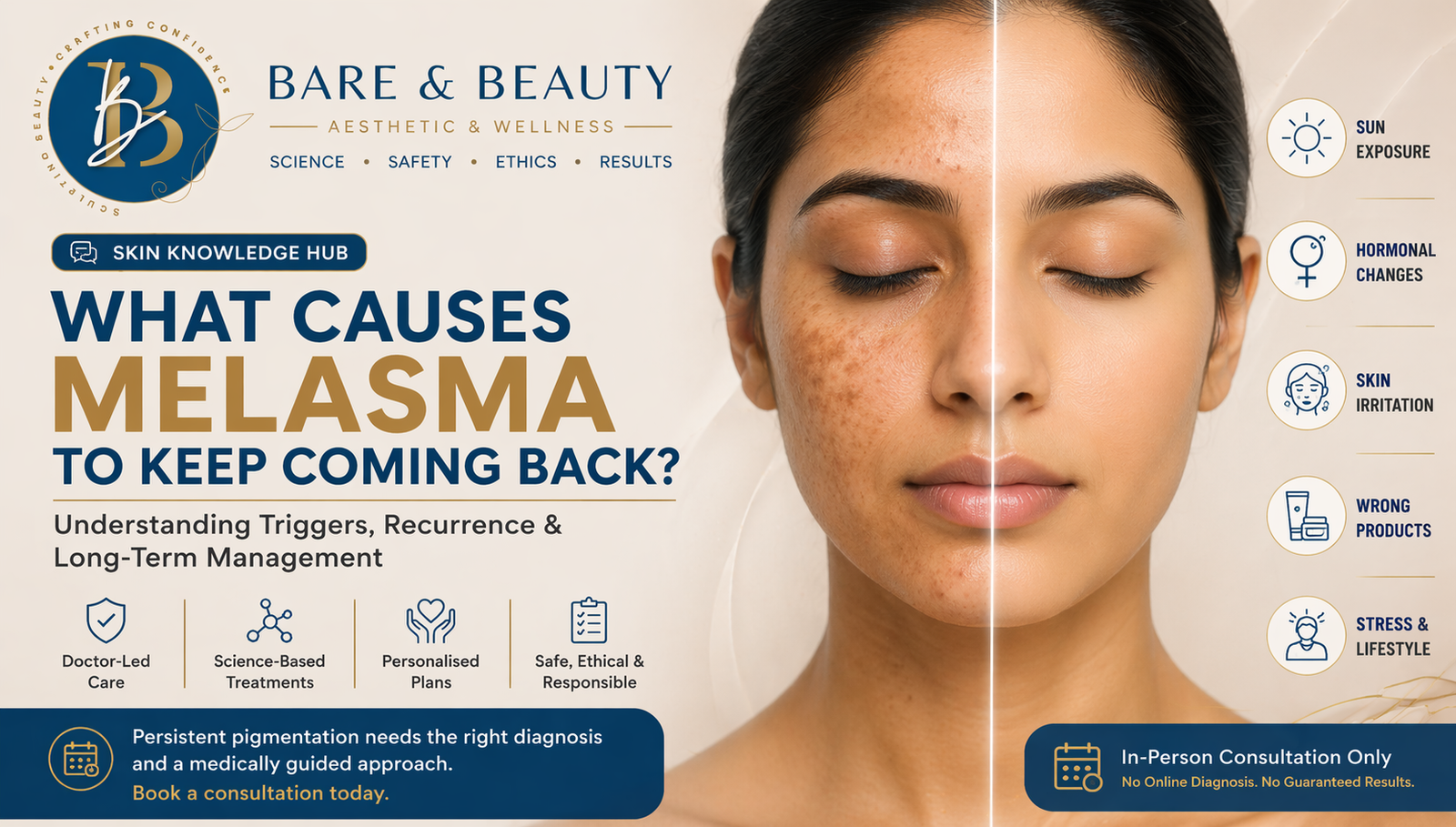
What Causes Melasma to Keep Coming Back?
Melasma is one of the most frustrating pigmentation concerns because it often improves, fades partially, and then reappears. Many people feel that the skin gets better for some time, only to notice the patches return after sun exposure, weather changes, hormonal shifts, stress, or a break in skin care routine.
This pattern is common. Melasma is not always a one-time skin event. It is usually a recurrent pigmentation condition that needs careful long-term management, realistic expectations, and an understanding of triggers.
At Bare & Beauty Aesthetic and Wellness, Noida, melasma is approached as a consultation-based pigmentation concern rather than something that can be reduced to a quick fairness promise or one universal treatment. The clinic’s treatment architecture includes dedicated pages for Melasma Treatment, Pigmentation & Discoloration Treatment, and related skin care support such as Chemical Peels, which reflects that pigmentation planning is structured, not generic.
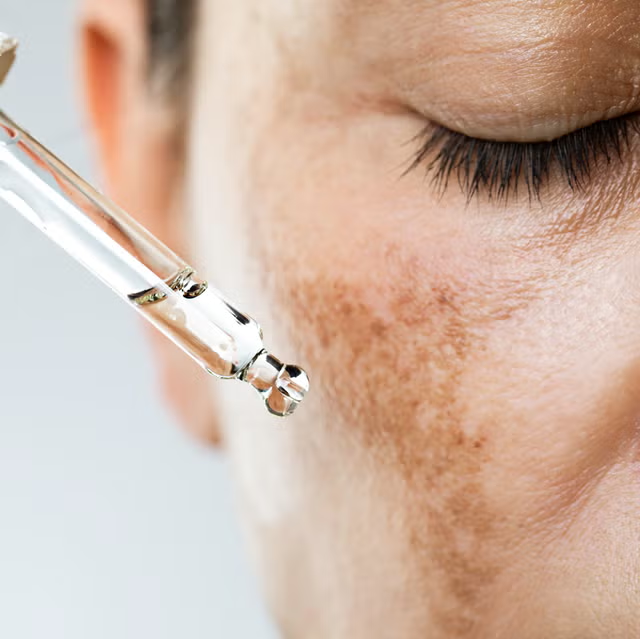
What is melasma?
Melasma is a pigmentation condition in which brown, grey-brown, or patchy discolouration develops on the skin, most commonly on:
- cheeks
- forehead
- upper lip
- nose
- chin
It is frequently seen in women, but men can also develop melasma. It is especially relevant in Indian skin, where pigmentation disorders can persist longer and become more noticeable with repeated triggers.
Melasma is different from a temporary tan or a random dark patch after a pimple. It tends to be more patterned, more stubborn, and more likely to return even after apparent improvement.
Why does melasma keep coming back?
The simplest answer is this: melasma is usually driven by multiple underlying triggers, not just one visible patch on the skin.
A person may improve the appearance for a while, but if the underlying triggers remain active, pigmentation can flare again.
In many cases, recurrence happens because:
- the skin remains pigment-sensitive
- triggers are still present
- treatment was stopped too early
- the skin barrier was not supported properly
- sun and heat exposure continued
- hormonal or lifestyle influences remained unchanged
That is why recurrence is so common.
The most common causes behind recurrent melasma
1. Sun exposure
Sun exposure is one of the biggest reasons melasma returns.
Even when a person feels they are “not out in the sun much,” repeated day-to-day exposure can still influence pigmentation. This includes:
- outdoor travel
- driving
- indirect daylight
- routine errands
- terrace or balcony exposure
- time near windows in strong daylight conditions
Melasma-prone skin often reacts strongly to repeated UV exposure. In Indian weather conditions, this becomes even more relevant.
A person may finish a treatment phase and see improvement, but if photoprotection is not consistent, the pigment can gradually reappear.
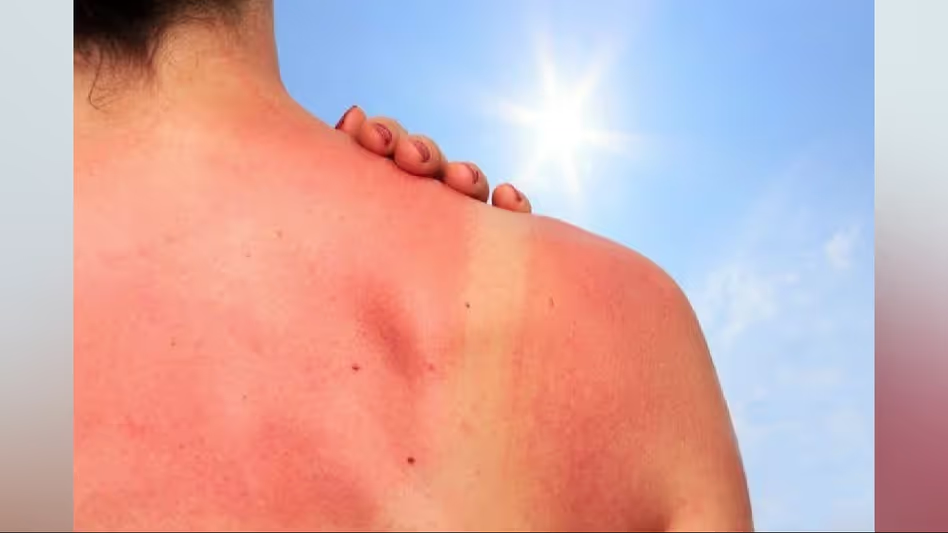
2. Heat and environmental exposure
Many people focus only on sunlight, but heat can also worsen melasma in some individuals.
Common contributors may include:
- high outdoor temperatures
- prolonged sweating
- hot kitchens
- steam-heavy environments
- heat-generating cosmetic habits
- repeated irritation in already sensitive skin
This is one reason melasma can flare in summer, after travel, or during periods of increased outdoor exposure even when sunscreen is being used inconsistently.
3. Hormonal influence
Hormonal shifts are strongly associated with melasma in many people.
This may be relevant during:
- pregnancy
- postpartum changes
- hormonal fluctuations
- use of certain hormone-influenced medication patterns
- other endocrine or internal changes that need proper medical assessment
Not every person with melasma has an obvious hormonal cause, but in many cases hormones play a role in why pigmentation behaves in a recurring way.
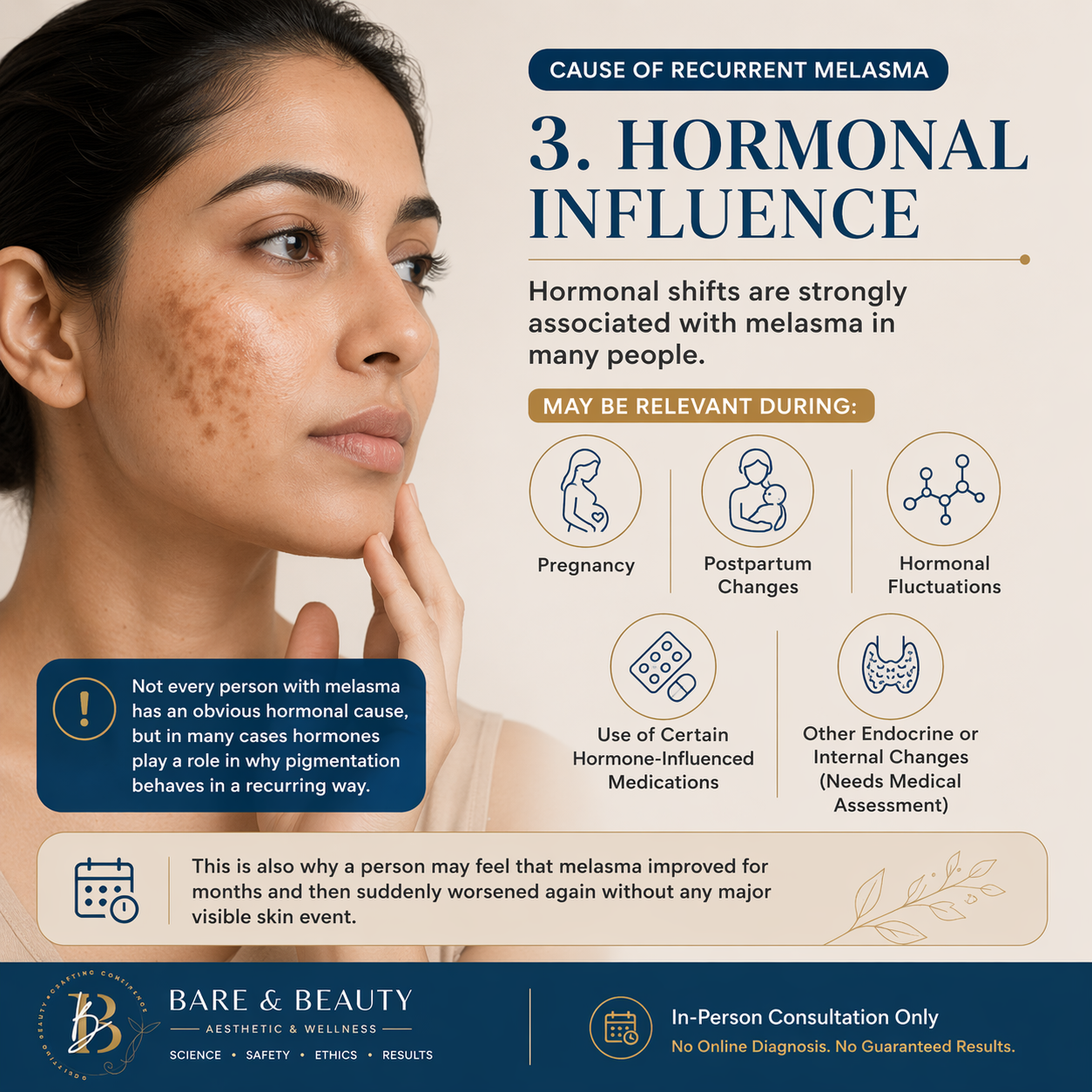
This is also why a person may feel that melasma improved for months and then suddenly worsened again without any major visible skin event.
4. Incomplete or short-term treatment expectations
A very common reason melasma seems to “come back” is that treatment was expected to behave like a one-time correction.
Melasma often does not work like that.
Some people:
- stop treatment too early
- stop maintenance too abruptly
- assume one peel or one laser session should permanently solve the issue
- move from one product to another without clinical consistency
When the improvement phase is not followed by maintenance thinking, recurrence is more likely.
5. Incorrect self-diagnosis
Not every facial pigmentation problem is melasma. And not every dark patch should be treated with aggressive brightening products.
Self-diagnosis can create two problems:
- the person may not actually be treating melasma
- the person may be irritating the skin and worsening pigmentation
People often try:
- harsh home exfoliation
- repeated acid use without supervision
- random online creams
- unsuitable cosmetic combinations
- products meant for acne marks rather than melasma
This can disturb the skin barrier and make pigmentation behave more unpredictably.
6. Skin barrier irritation
Pigmentation-prone skin often worsens when the skin is repeatedly irritated.
Barrier damage may happen due to:
- over-exfoliation
- too many active ingredients
- harsh scrubbing
- unsuitable facials
- picking, rubbing, or friction
- using products without understanding skin type
Irritated skin does not always become obviously red. Sometimes it simply becomes more reactive, more uneven, and more prone to persistent pigmentation.
This is especially important in Indian skin, where irritation can leave longer-lasting discolouration.
7. Recurrence tendency in Indian skin
Indian skin often needs cautious pigmentation planning because:
- pigment can get activated more easily
- even mild inflammation can leave visible discolouration
- tanning and patchy rebound can overlap
- repeated “trial-and-error” treatment can worsen unevenness
That is why melasma in Indian skin needs a thoughtful, medically guided approach rather than aggressive over-treatment.
Why melasma is difficult to “cure permanently”
This is one of the most important patient education points.
Melasma is often not managed as a simple “remove and forget” condition. It is better understood as a chronic pigmentation tendency in many individuals.
That means:
- improvement is possible
- control is possible
- skin tone may become more even
- flare frequency may reduce
- but recurrence risk can remain
This does not mean treatment is pointless. It means treatment should be planned with honesty.
Bare & Beauty’s content and policy system clearly avoids guaranteed-result language and states that treatments are consultation-based, minimally invasive, and subject to individual variability.
A practical table: why melasma returns
| Trigger or factor | How it affects melasma | Why it matters in treatment planning |
|---|---|---|
| Sun exposure | Reactivates pigment production | Ongoing photoprotection becomes essential |
| Heat exposure | Can worsen pigment tendency in some people | Lifestyle advice may matter alongside procedures |
| Hormonal shifts | May deepen or reactivate pigmentation | History-taking becomes important |
| Stopping treatment too early | Skin improves briefly, then relapses | Maintenance planning is often needed |
| Wrong products or self-treatment | Can irritate skin and worsen pigmentation | Professional diagnosis helps avoid this |
| Over-exfoliation | Weakens barrier and increases sensitivity | Gentle, suitable planning is safer |
| Indian skin pigment response | Pigmentation may persist longer | Conservative, tailored treatment is important |
| Unrealistic expectations | Leads to repeated switching and frustration | Education and long-term planning improve compliance |
Why one person’s melasma journey looks different from another’s
Two people may both say they have melasma, but the actual clinical picture may differ a lot.
Differences may include:
- how deep the pigmentation is
- how long it has been present
- whether it overlaps with tanning or post-inflammatory pigmentation
- how much sun or heat exposure is ongoing
- whether the skin is sensitive or resilient
- whether hormonal history is relevant
- whether there is previous treatment history
- how consistent the patient can realistically be with long-term care
That is why treatment planning cannot be identical for every patient.
How melasma is usually approached clinically
At a consultation-led clinic, the first step is usually not to “sell a session.”
It is to assess:
- whether the pigmentation pattern looks consistent with melasma
- whether there are overlapping concerns
- whether the skin is currently irritated
- whether a peel-based, topical, or procedure-supported approach is more suitable
- what expectations are realistic
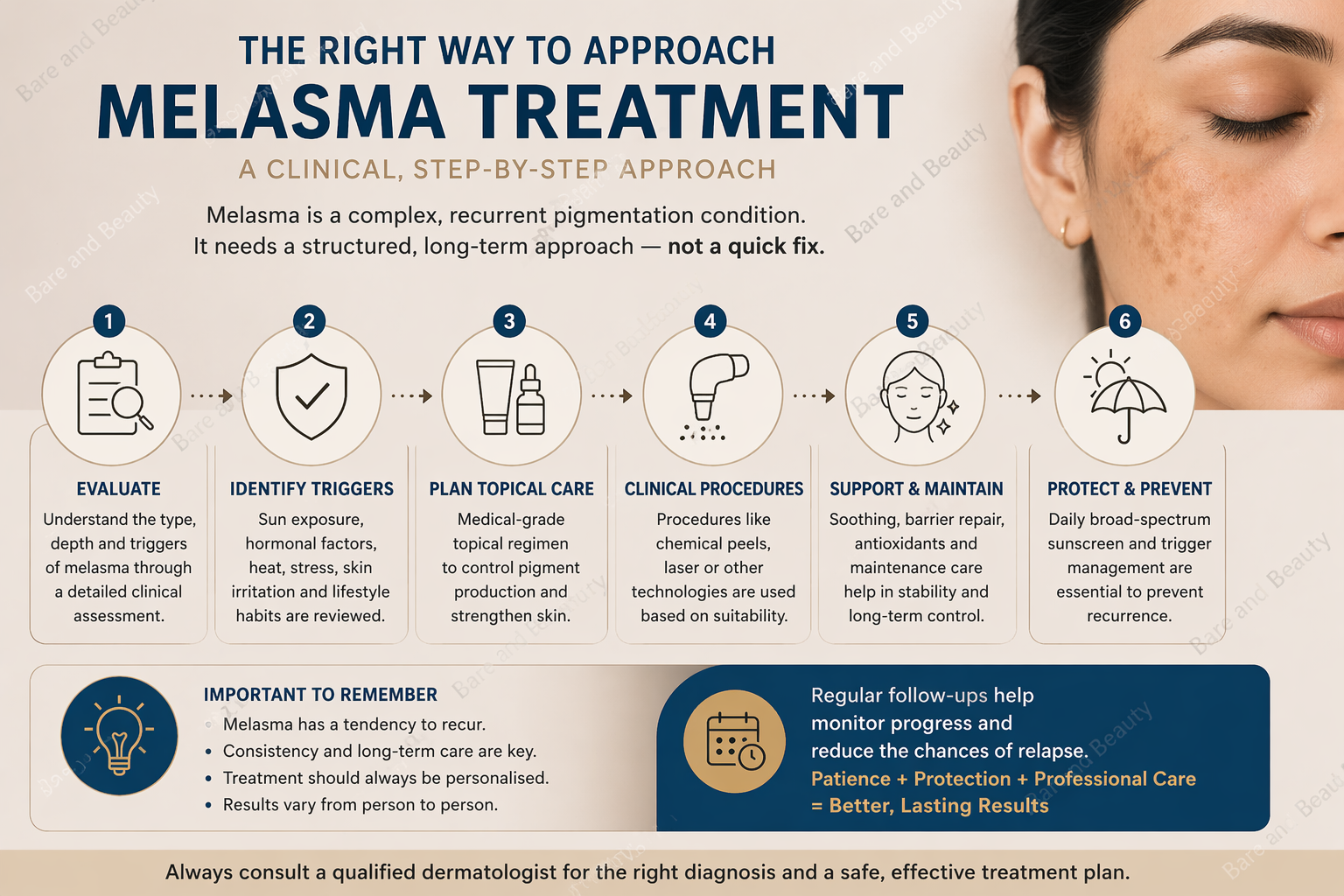
This fits Bare & Beauty’s overall content system, which requires patient-first, structured, ethical content and makes it clear that all treatment suitability decisions follow in-person assessment and consent.
Can melasma worsen with the wrong treatment choice?
Yes, in some cases it can.
Pigmentation-prone skin does not always respond well to random or overly aggressive intervention. That is why evaluation matters before deciding what approach is suitable.
A person may worsen melasma or create uneven pigmentation when:
- chasing “instant fairness” messaging
- combining too many active products
- repeating unsupervised peels
- not respecting skin recovery time
- ignoring the importance of maintenance
This is also why realistic medical communication matters. Bare & Beauty’s policy framework clearly states that no treatment is initiated without proper evaluation and informed consent, and that individual results vary.
Why long-term thinking matters more than quick fixes
Melasma often tests patience. People want visible improvement quickly, but recurrence risk is exactly why long-term thinking matters.
A better patient mindset is:
- understand the trigger pattern
- improve the current pigmentation
- reduce avoidable aggravators
- stay consistent
- avoid over-correcting
- review progress when needed
This tends to work better than cycling through random creams, cosmetic advice, and internet trends.
When should someone seek professional melasma evaluation?
Consider a consultation if:
- pigmentation keeps returning after temporary improvement
- facial patches are becoming darker or more widespread
- over-the-counter products are not helping
- the skin feels irritated from repeated self-treatment
- you are not sure whether it is melasma, tanning, or another pigmentation issue
- pigmentation is affecting confidence, social comfort, or routine grooming decisions
How Bare & Beauty positions care for pigmentation concerns
Bare & Beauty’s skin treatment inventory includes dedicated clinical services for:
- Melasma Treatment
- Pigmentation & Discoloration Treatment
- Chemical Peels
- related skin support within the broader Skin Treatments category.
The clinic’s framework also makes clear that:
- treatments are minimally invasive
- suitability is decided after in-person consultation
- there are no guarantees
- plans are personalised
- consent and ethical communication are non-negotiable.
That makes this blog a trust-building educational asset, not just an SEO post.
Final word
Melasma often keeps coming back because the visible pigmentation is only one part of the problem. The deeper issue is usually ongoing trigger sensitivity — especially to sun, heat, hormonal influences, barrier irritation, and inconsistent long-term care.
That is why melasma needs more than a quick product recommendation. It needs correct diagnosis, trigger awareness, realistic planning, and patient consistency.
If your pigmentation improves and then returns again, the issue may not be that treatment “failed.” It may be that the skin needs a more structured and medically guided approach.
For people in Noida looking for consultation-based support, Bare & Beauty’s melasma and pigmentation treatment pathway is designed around individual assessment, ethical planning, and realistic expectation setting rather than over-promising outcomes.
1. Why does melasma come back even after treatment?
Melasma can return because the skin remains sensitive to common triggers such as sunlight, heat, hormonal changes, irritation, and inconsistent long-term care.
2. Is melasma permanent?
Melasma is not always permanent in the same intensity, but it can be recurrent. Many people see improvement and then experience flare-ups again if triggers remain active.
3. Can sunscreen alone stop melasma from returning?
Sun protection is important, but melasma is often influenced by multiple factors. In many cases, proper assessment, supportive treatment, and ongoing care are also needed.
4. Is melasma common in Indian skin?
Yes. Pigmentation concerns, including melasma, are especially relevant in Indian skin, where dark patches may persist longer and require careful treatment selection.
5. Can home remedies remove melasma permanently?
Home remedies and unsupervised product use may not be enough and can sometimes irritate the skin further. Persistent or recurrent melasma is better assessed professionally.
6. When should I see a clinic for melasma?
You should consider consultation when pigmentation keeps returning, gets darker, does not respond to routine care, or is affecting your confidence and daily comfort.