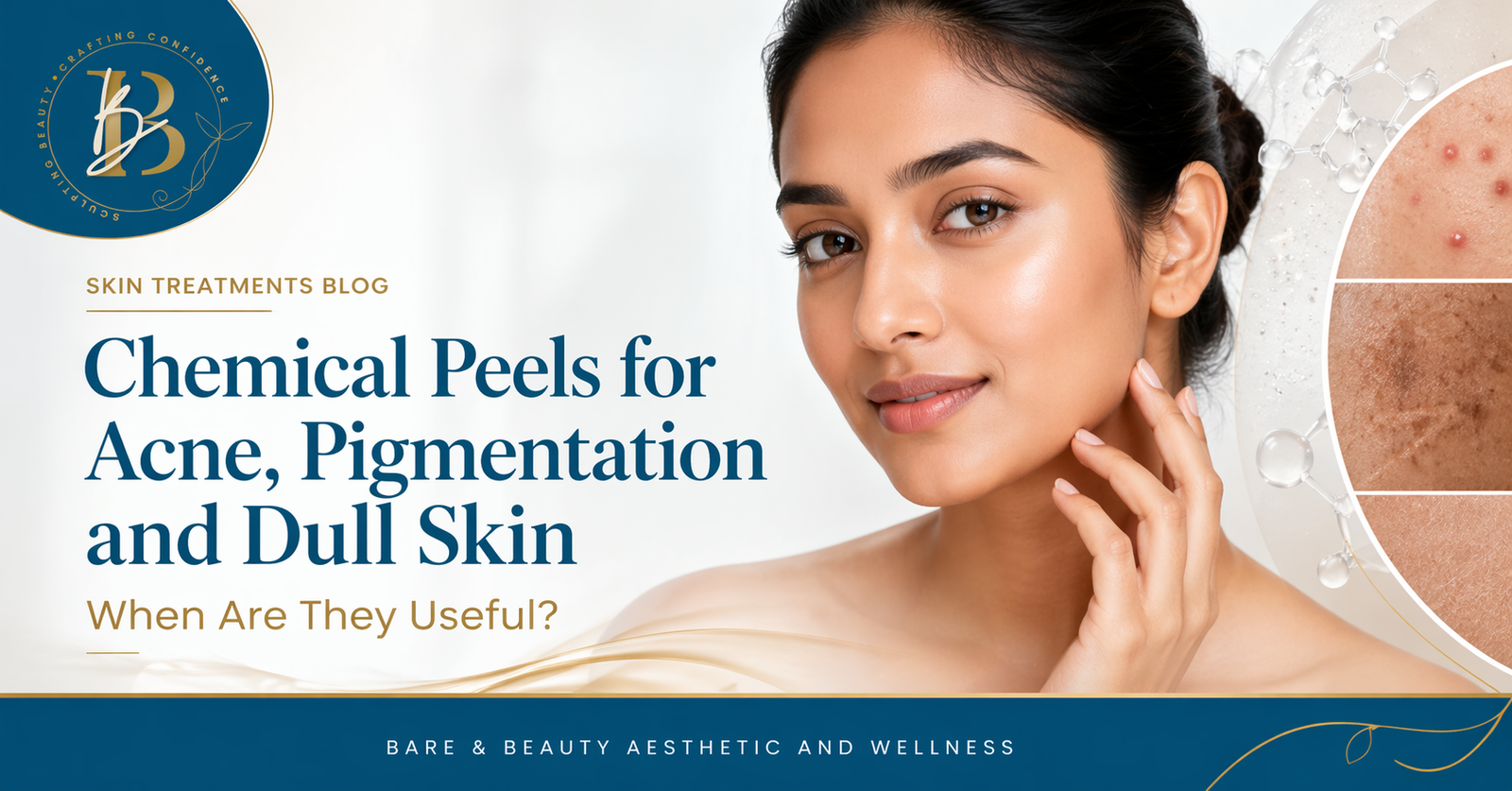
Chemical Peels for Acne, Pigmentation and Dull Skin: When Are They Useful?
Chemical peels are among the most commonly discussed skin treatments, yet they are also among the most misunderstood. Many people assume a peel is simply a quick glow treatment or a one-size-fits-all option for uneven skin. In reality, chemical peels are better understood as clinical skin treatments whose usefulness depends on the concern being treated, the condition of the skin barrier, the person’s skin type, and the overall treatment plan.
This matters because the same peel approach is not suitable for everyone. A person dealing with active acne may need a very different peel strategy from someone dealing with pigmentation, post-acne marks, or a generally dull complexion. In Indian skin especially, treatment planning has to be careful, not aggressive, because the skin may respond to irritation with further pigmentation or prolonged unevenness.
At Bare & Beauty Aesthetic and Wellness, Noida, peel-related care sits within a larger skin-treatment pathway that already includes dedicated pages for Chemical Peels, Cosmelan Peel, Pigmentation & Discoloration Treatment, Acne Treatment, and the broader Skin Treatments hub. The site structure itself makes it clear that peels are part of a medically guided skin-care framework, not an isolated cosmetic add-on.
What are chemical peels in a clinical skin-treatment context?
A chemical peel is a professionally selected skin treatment that uses specific peeling agents to support controlled exfoliation and skin renewal. In a clinical context, the goal is not simply to make the skin look polished for a few days. The goal is to address a defined concern in a structured way.
Depending on the indication, chemical peels may be considered to support:
- acne-prone skin
- post-acne marks
- uneven skin tone
- certain pigmentation concerns
- dull or rough-looking skin
- selected textural irregularities
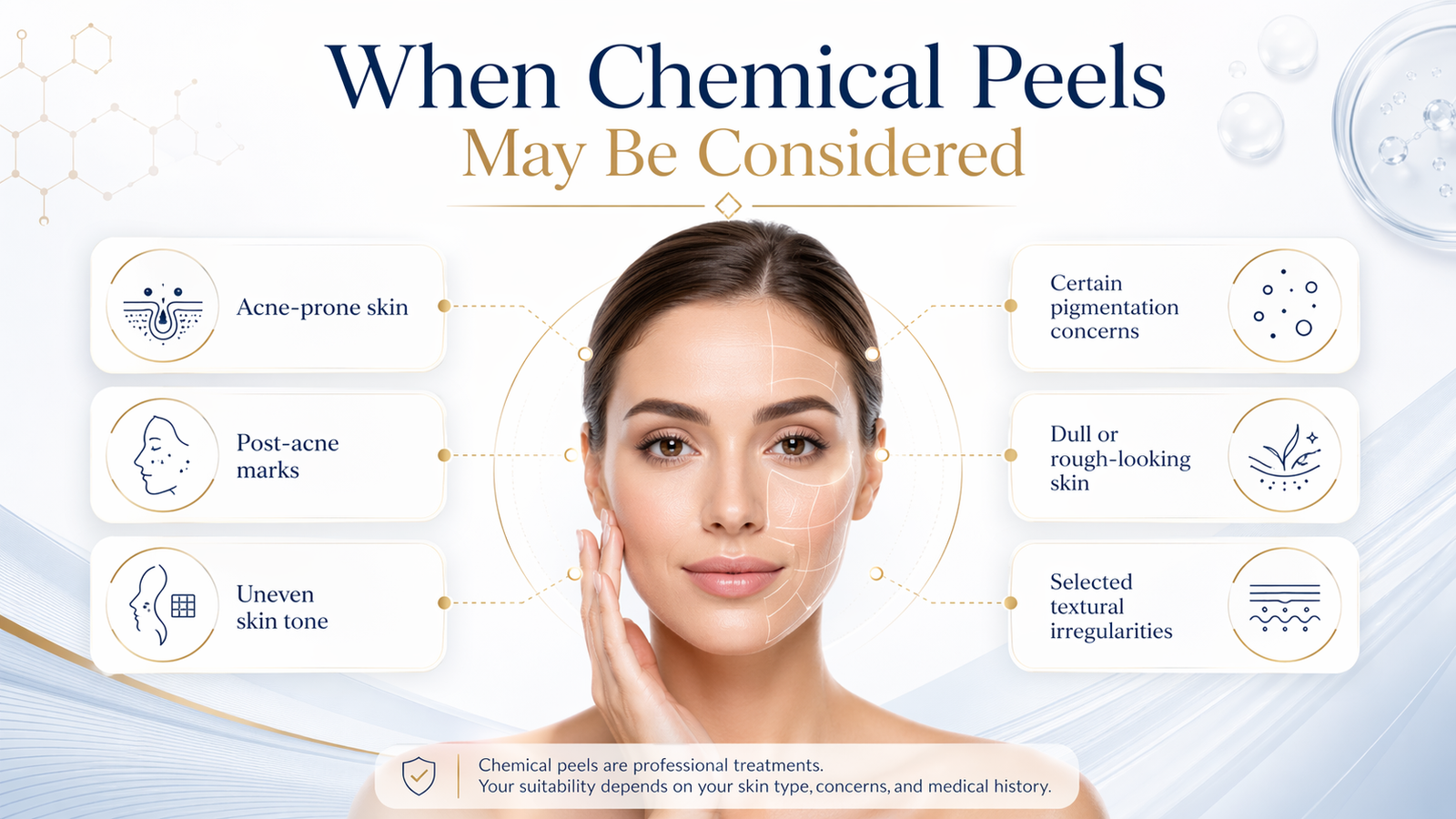
Not every peel has the same depth, intensity, or purpose. Some are chosen for relatively superficial support, while others are used more strategically as part of a pigmentation or acne-management plan.
Why not all peels are the same
This is one of the most important things for patients to understand.
Different peels may vary in:
- composition
- strength
- depth of action
- downtime
- suitability for sensitive skin
- suitability for pigmentation-prone skin
- role in acne versus melasma versus dull skin
So when someone asks, “Should I get a chemical peel?”, the more useful question is actually:
Which skin concern is being treated, and is a peel even the right first step?
Why Indian skin needs extra caution
Indian skin often requires more thoughtful treatment planning because it can be more pigment-reactive after irritation, inflammation, or excessive treatment. That means a peel may be useful, but peel selection, intensity, timing, and aftercare all matter.
This is why self-treatment or trend-led treatment can backfire. A peel that is too strong, too frequent, or not suited to the concern may leave the skin more reactive rather than more balanced.
When are chemical peels commonly considered useful?
Chemical peels may be useful in selected cases, but the reason for using them changes depending on the concern.
1. For acne-prone skin in selected cases
In some acne-prone patients, peels may be used as part of a broader acne-management approach. The aim is not to “burn off acne” or create instant clarity. Rather, peels may be considered to support:
- reduction of congestion
- oil-control support in selected cases
- smoother surface turnover
- management of post-acne residual unevenness
- supportive care within an acne treatment plan
This does not mean every person with acne should start with a peel. If the skin is highly inflamed, irritated, barrier-damaged, or undergoing an active flare, the first priority may be to calm the skin rather than intensify treatment.
2. For pigmentation and uneven tone
Pigmentation is one of the most common reasons people ask about chemical peels. This includes:
- post-inflammatory pigmentation
- patchy dullness
- uneven tone
- selected superficial pigmentation concerns
However, pigmentation is not one single problem. Some pigment changes respond better than others, and in some cases a peel is only one part of the treatment strategy rather than the complete answer.
For people already dealing with melasma or more persistent facial pigmentation, a peel may need to be chosen more carefully or used only as part of a larger pigmentation-management plan.
3. For dull skin and surface irregularity
Some people do not have significant acne or pigmentation, but feel that their skin looks tired, uneven, rough, or lacking radiance. In such cases, selected peels may be considered when the skin needs:
- controlled exfoliation
- surface refresh
- support for uneven texture
- improvement in a tired-looking complexion
That said, dull skin can also be linked to dehydration, poor skin barrier function, irritation, excessive exfoliation, poor sleep, or unsuitable skin care. So not all dull skin automatically needs a peel.
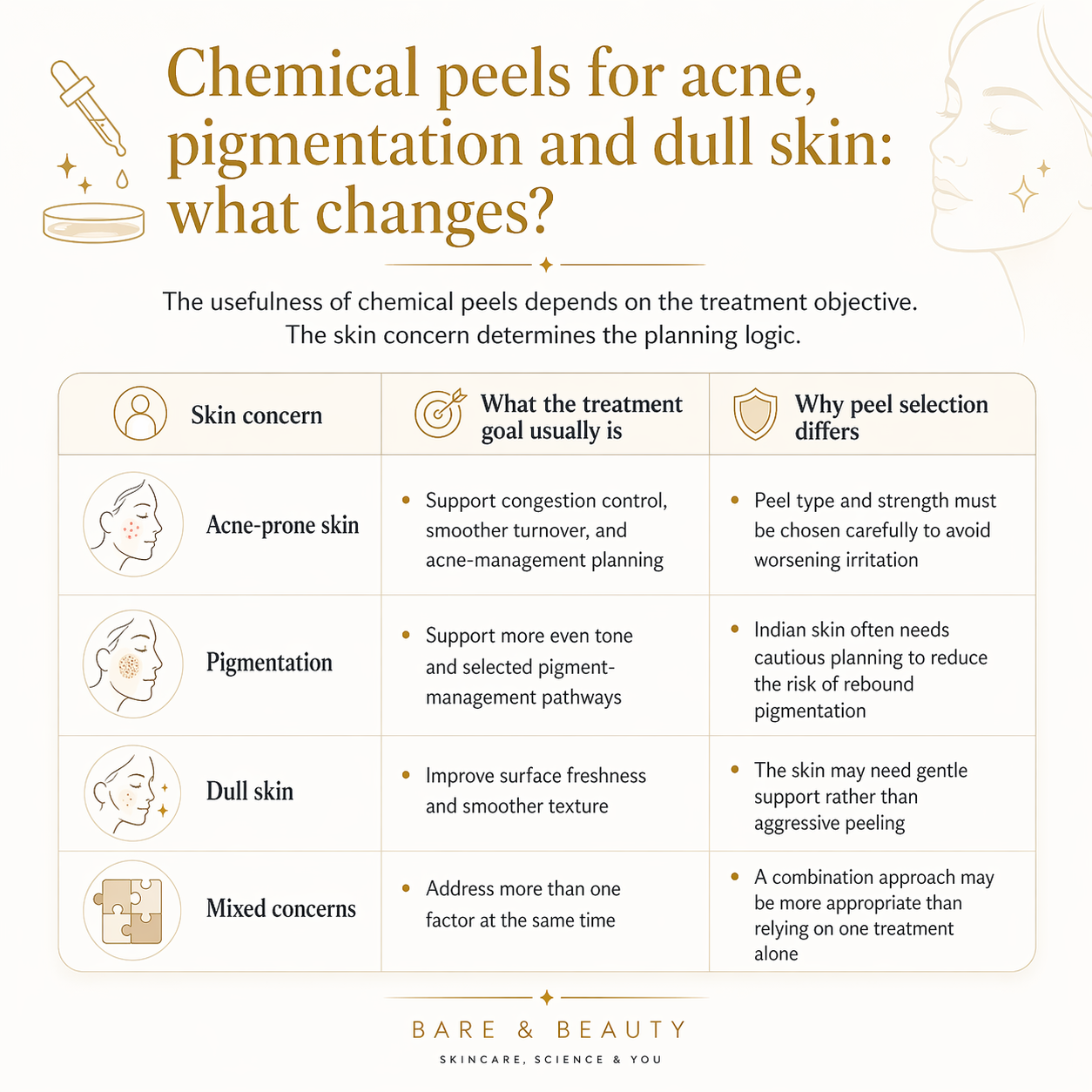
Chemical peels for acne, pigmentation and dull skin: what changes?
The usefulness of chemical peels depends on the treatment objective. The skin concern determines the planning logic.
| Skin concern | What the treatment goal usually is | Why peel selection differs |
|---|---|---|
| Acne-prone skin | Support congestion control, smoother turnover, and acne-management planning | Peel type and strength must be chosen carefully to avoid worsening irritation |
| Pigmentation | Support more even tone and selected pigment-management pathways | Indian skin often needs cautious planning to reduce the risk of rebound pigmentation |
| Dull skin | Improve surface freshness and smoother texture | The skin may need gentle support rather than aggressive peeling |
| Mixed concerns | Address more than one factor at the same time | A combination approach may be more appropriate than relying on one treatment alone |
This is exactly why no clinically responsible clinic should present all chemical peels as interchangeable.
When chemical peels may not be the first treatment choice
A peel may be useful, but it is not automatically the first recommendation in every case.
Situations where more caution may be needed include:
- highly sensitive or barrier-compromised skin
- active irritation from home skin care
- very inflamed acne flare-ups
- severe or recurrent melasma without proper assessment
- unrealistic expectations of one-session correction
- recent overuse of exfoliating products
- uncertain diagnosis of the skin concern
In some cases, the better first step may be:
- restoring the skin barrier
- clarifying the diagnosis
- improving home routine compliance
- treating inflammation first
- considering a different or staged treatment pathway
This is where professional assessment protects both skin health and long-term results.
Chemical peels and pigmentation: are they always enough?
Not necessarily.
Pigmentation-related concerns often overlap with:
- melasma
- tanning
- post-inflammatory marks
- skin sensitivity
- heat-triggered or sun-triggered darkening
- patchy rebound pigmentation from irritation
That is why a pigmentation-focused patient may not always be advised the same approach as someone with only mild dullness. In some cases, a regular peel-based plan may be discussed. In others, a more targeted pigmentation pathway may be considered.
This is where a page like Cosmelan Peel becomes strategically important in Bare & Beauty’s structure. The site already distinguishes between general Chemical Peels and a dedicated Cosmelan Peel page, which reflects an important clinical truth: not every pigmentation concern should be treated as ordinary peel-friendly uneven tone. Some concerns require more specific planning.
How does a Cosmelan-type pathway differ from regular peel conversations?
Without oversimplifying, a pigmentation-focused treatment pathway is generally discussed differently from a regular “peel for glow” conversation.
A dedicated pigmentation-management option may be considered when:
- pigmentation is more resistant
- melasma or patchy facial discolouration is part of the picture
- standard skin-brightening routines have not helped enough
- a more targeted pigment-management plan is needed
This does not mean one option is “better” for everyone. It means the diagnosis and treatment goal matter.
That is why it is useful for Bare & Beauty to internally connect:
- Chemical Peels
- Cosmelan Peel
- Pigmentation & Discoloration Treatment
These are related, but not identical, treatment conversations.
Why chemical peels must be chosen carefully in Indian skin
Indian skin often responds strongly to inflammation and irritation. Even when the treatment intention is good, the wrong intensity or poor aftercare can create uneven results.
Key reasons cautious planning matters:
- pigment rebound may happen after irritation
- over-exfoliation can weaken the skin barrier
- sensitive skin may react unpredictably
- self-treatment history can complicate outcomes
- climate, heat and sun exposure can worsen pigment behaviour
This is why chemical peels should not be positioned like quick salon-style facials. Bare & Beauty’s treatment inventory and content workflow both position these as clinical skin services that require in-person consultation, informed consent, and individual suitability assessment rather than casual selection.
What professional assessment usually looks at before recommending a peel
A proper skin evaluation helps determine whether a peel is likely to be helpful, premature, or unsuitable at that stage.
Factors commonly considered include:
- the actual skin concern
- whether the issue is acne, pigmentation, dullness, or a combination
- current inflammation level
- skin sensitivity and barrier condition
- past treatment history
- pigmentation tendency
- current product use
- tolerance for downtime
- expectations and time horizon
This is why consultation-led care matters.
Bare & Beauty’s workflow is already built around this logic: no online diagnosis, no invented claims, no guaranteed results, and content that stays medically grounded and patient-friendly.
What to expect from treatment planning
A clinically responsible peel discussion should include expectation management.
Patients should understand:
- one session is not always enough
- peel selection varies by indication
- some cases may need combination planning
- results vary by skin type, condition, and compliance
- maintenance may matter in recurrent concerns
- not every concern improves at the same speed
This is especially important for pigmentation concerns. Patients often expect one peel to fully “clear” the skin. That expectation is rarely realistic and is not aligned with Bare & Beauty’s broader ethics and no-guarantee content system.
When should you seek professional evaluation for chemical peel treatment?
Consider a consultation-based skin assessment if:
- acne marks are lingering
- pigmentation keeps returning
- your skin looks persistently dull despite skin care
- products are causing irritation
- you are unsure whether the concern is acne, melasma, tan, or surface dullness
- you are considering a peel but do not know if it is actually suitable for your skin
How this blog should support Bare & Beauty’s internal SEO structure
This blog should naturally support the following internal links:
Primary internal link
- Chemical Peels → primary service page
Secondary internal links
- Cosmelan Peel
- Pigmentation & Discoloration Treatment
Contextual support links
- Acne Treatment
- Skin Treatments
This is the correct internal-linking logic because the Bare & Beauty site already has these pages live within the locked skin-treatment cluster, and the content workflow explicitly requires logical, non-random linking.
Final word
Chemical peels can be useful for acne-prone skin, selected pigmentation concerns, and dull-looking skin — but only when they are chosen for the right indication and the right skin.
A peel is not automatically a glow treatment, and it is not always the first answer for every concern. In some cases, a peel may support improvement. In other cases, the skin may first need diagnosis clarification, barrier repair, acne control, or a more targeted pigmentation-management pathway.
The most useful question is not simply, “Should I get a peel?”
It is:
What is my skin actually dealing with, and is a peel the right next step?
If you are considering chemical peel treatment in Noida, a consultation-based evaluation at Bare & Beauty can help determine whether the concern is acne-related, pigmentation-related, dullness-related, or a combination that needs more careful planning.
FAQS
1. Are chemical peels useful for acne?
Chemical peels may be useful in selected acne-prone cases as part of a broader treatment plan. Their role depends on the type of acne, inflammation level, and overall skin condition.
2. Can chemical peels help pigmentation?
Chemical peels may help certain pigmentation concerns, but not all pigmentation behaves the same way. Proper assessment is important, especially in Indian skin and in recurrent pigmentation concerns.
3. Are chemical peels safe for Indian skin?
They can be suitable when properly selected and professionally performed. Indian skin often needs careful planning because it may be more prone to irritation-related pigmentation changes.
4. Is Cosmelan Peel the same as a regular chemical peel?
Not exactly. While both may be discussed within pigmentation treatment planning, Cosmelan-type pathways are generally considered more specifically for pigment-management concerns rather than general peel conversations.
5. Can chemical peels help dull skin?
Yes, in selected cases chemical peels may support smoother, fresher-looking skin. However, dullness can also be caused by dehydration, irritation, poor routine, or barrier damage, so assessment still matters.
6. How do I know if a chemical peel is right for me?
A professional consultation is the safest way to determine suitability. The recommendation depends on your skin concern, sensitivity, current routine, pigmentation tendency, and treatment goals.
7. Can chemical peels permanently remove pigmentation?
No treatment should be framed as a guaranteed permanent solution. Pigmentation may improve differently from person to person, and some conditions may need maintenance or combination planning.