Pigmentation in Indian Skin: Why Treatment Must Be Chosen Carefully Before Peels or Laser
Pigmentation is one of the most common skin concerns seen in aesthetic and dermatology practice. Many people use the word “pigmentation” broadly to describe dark patches, uneven tone, tanning, marks after acne, or recurring facial discolouration. But clinically, these concerns are not always the same.
That difference matters even more in Indian skin.
In Indian skin types, pigmentation can sometimes behave in a more reactive way. Irritation, inflammation, heat exposure, aggressive self-treatment, the wrong peel, or an unsuitable laser pathway may worsen the appearance instead of improving it. This is why treatment should not be chosen only on the basis of a social media trend, a product recommendation, or someone else’s experience.
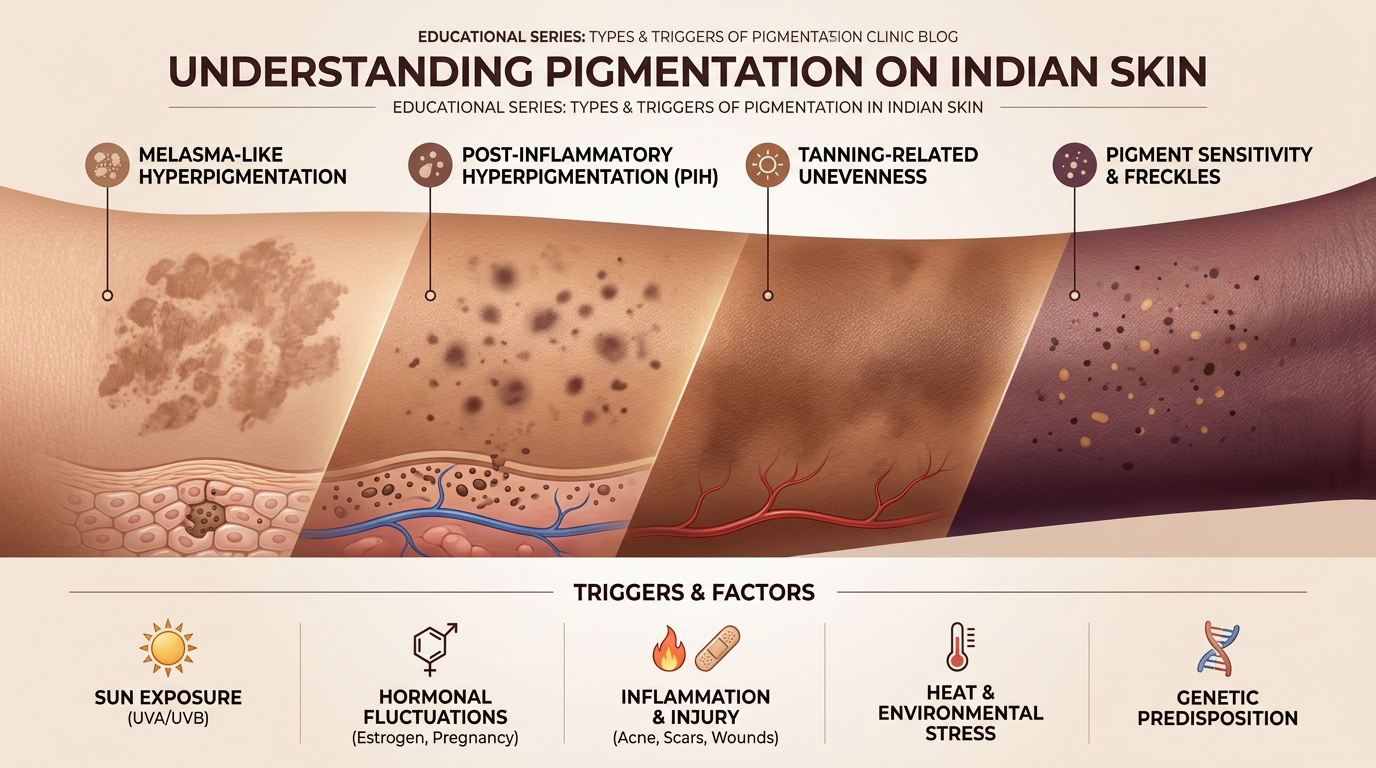
At Bare & Beauty Aesthetic and Wellness, the locked treatment structure already separates Pigmentation & Discoloration Treatment, Melasma Treatment, and Q-Switch Laser Treatment, which reflects an important clinical truth: not all pigmentation should be grouped into one treatment conversation.
A better approach begins with one question:
What kind of pigmentation is this, and what is the safest way to approach it in this skin?
Why pigmentation in Indian skin needs extra caution
Pigmentation treatment in Indian skin is not just about making the skin look brighter. It is about choosing a treatment pathway that respects how the skin behaves.
In many people, Indian skin may be more prone to:
- post-inflammatory darkening after irritation
- rebound pigmentation
- recurrence in conditions such as melasma
- sun- and heat-triggered worsening
- mixed pigmentation patterns rather than one simple cause
This does not mean Indian skin cannot respond well to treatment. It means the planning needs to be more careful.
A procedure that looks straightforward online may not be the right first step for someone whose skin is already sensitive, inflammation-prone, or pigmentation-reactive.
What kinds of pigmentation may look similar but behave differently?
One of the reasons pigmentation treatment often gets delayed or mismanaged is that multiple conditions can look similar on the face.
Some common possibilities include:
- melasma
- post-inflammatory pigmentation after acne or irritation
- tanning-related uneven tone
- marks after procedures or friction
- patchy facial discolouration linked to mixed triggers
- recurrent pigmentation that improves temporarily and returns
A brown patch on the cheek is not always the same as pigmentation after acne. Pigmentation near the upper lip may behave differently from diffuse tanning. Dark patches that worsen repeatedly may point toward melasma-like behaviour rather than simple uneven tone.
This is why treatment should begin with diagnosis logic, not only appearance.
Why treatment should not be chosen only by trends
Today, many people first hear about pigmentation treatment through:
- social media videos
- influencer skincare
- over-the-counter actives
- peel recommendations
- laser reels and “instant glow” content
The problem is that trend-led treatment often ignores:
- skin type
- cause of pigmentation
- history of recurrence
- barrier sensitivity
- previous irritation
- sun habits
- whether melasma may be involved
This can lead to:
- over-exfoliation
- steroid misuse through random creams
- aggressive peels
- unsuitable laser selection
- frustration when pigmentation comes back
For a premium clinic like Bare & Beauty, the right stance is not to promote a trendy treatment first. It is to guide the patient toward the safest medically appropriate option after consultation.
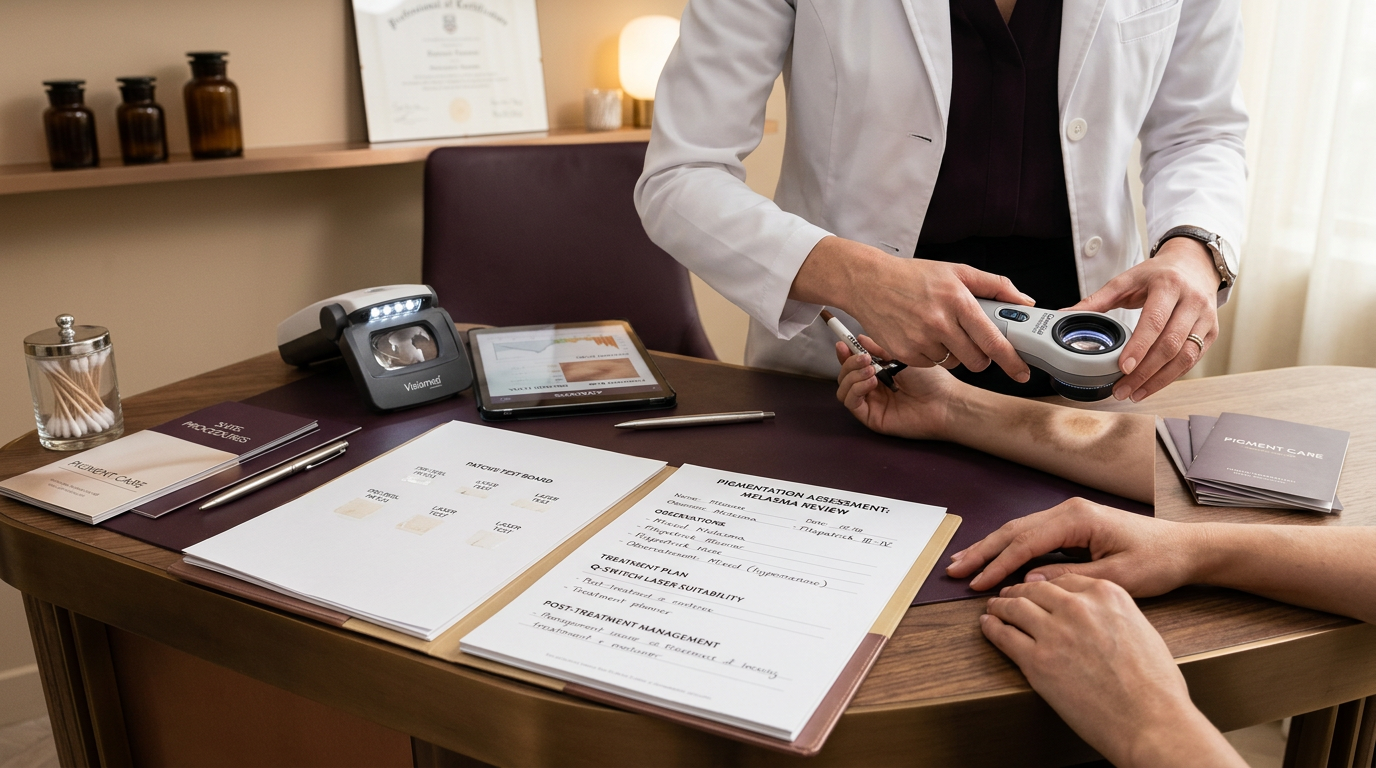
What may a doctor evaluate before selecting pigmentation treatment?
Before deciding whether a patient may be suitable for topical correction, peels, laser, or a more specific pigmentation pathway, a doctor may assess the concern more carefully.
This evaluation may include:
- how long the pigmentation has been present
- whether it is recurring or newly noticed
- which areas are affected
- whether the pattern looks patchy, diffuse, or post-inflammatory
- whether there is a history of melasma or hormonal triggers
- whether previous peels, lasers, or creams were used
- whether the skin is sensitive or easily irritated
- whether the patient has frequent sun or heat exposure
- whether acne, friction, or inflammation preceded the pigmentation
- how realistic the patient’s expectations are
This kind of evaluation matters because Bare & Beauty’s content and policy structure makes clear that treatment suitability must be based on in-person medical assessment, with no guaranteed outcomes and no online diagnosis.
What assessments or tests may be advised in selected pigmentation cases?
Not every patient with pigmentation needs tests. But not every pigmentation concern should be handled only as a cosmetic issue either.
Depending on the history, pattern, and suspected cause, a doctor may sometimes advise selected assessment steps before deciding the treatment pathway.
These may include:
- careful clinical skin examination under proper lighting
- review of current skin-care products and previous treatment history
- test-spot or cautious treatment selection in certain cases where clinically appropriate
- assessment of recurrence pattern if melasma is suspected
- internal review where hormonal or systemic contributors seem relevant
- selected blood tests in some cases, depending on the history
Where clinically indicated, this may include conservative investigation such as:
- thyroid profile
- blood sugar or HbA1c where relevant
- selected nutritional review if the clinical picture suggests it
- broader medical review where the pigmentation history raises concern
The key point is this:
not every person needs every test, but some patients do need more than a surface-level recommendation.
That kind of cause-based evaluation improves both safety and treatment logic.
What habits and lifestyle factors may keep pigmentation active or recurrent?
This is where E-E-A-T becomes particularly strong, because pigmentation is not managed only by procedures.
Several habits may keep pigmentation active or make improvement harder:
- poor sunscreen compliance
- frequent heat and sun exposure
- picking, rubbing, or friction over affected areas
- random use of strong active ingredients
- over-exfoliation
- inconsistent skin-care routine
- poor adherence to aftercare
- steroid-containing or unsuitable creams used without supervision
- sleep disturbance and stress, which may affect routine consistency and skin recovery
Many patients feel that “the treatment did not work,” when the real issue is that the trigger pattern was never controlled.
This is also consistent with Bare & Beauty’s policy framework, which explicitly states that results vary from person to person and are influenced by factors such as lifestyle, biological response, treatment protocol, and compliance.
When melasma needs a different conversation
Melasma deserves separate attention because it is often one of the most frustrating forms of pigmentation for patients.
Melasma may:
- improve for some time and return
- worsen with sun or heat
- behave in a recurring way
- be influenced by hormonal context
- need more caution than ordinary uneven tone
This is why Bare & Beauty has a separate Melasma Treatment page within the skin cluster. That page distinction is useful from both a clinical and SEO perspective because it prevents oversimplifying melasma into a generic “pigmentation treatment” conversation.
If a doctor suspects melasma-like behaviour, treatment planning may need to be more conservative, more maintenance-aware, and more focused on trigger reduction.
When Q-Switch Laser may be discussed
Patients often search directly for “laser for pigmentation,” but laser is not a universal answer for every case.
Q-Switch Laser Treatment may be discussed in selected pigmentation situations after proper assessment. Bare & Beauty already lists Q-Switch Laser Treatment as part of its laser and pigmentation ecosystem.
However, the right way to frame it is:
- it may be relevant in selected cases
- suitability depends on the pigmentation type
- doctor judgement matters
- Indian skin needs careful planning
- not every patch is “laser-ready”
This avoids overclaiming and protects both trust and outcomes.
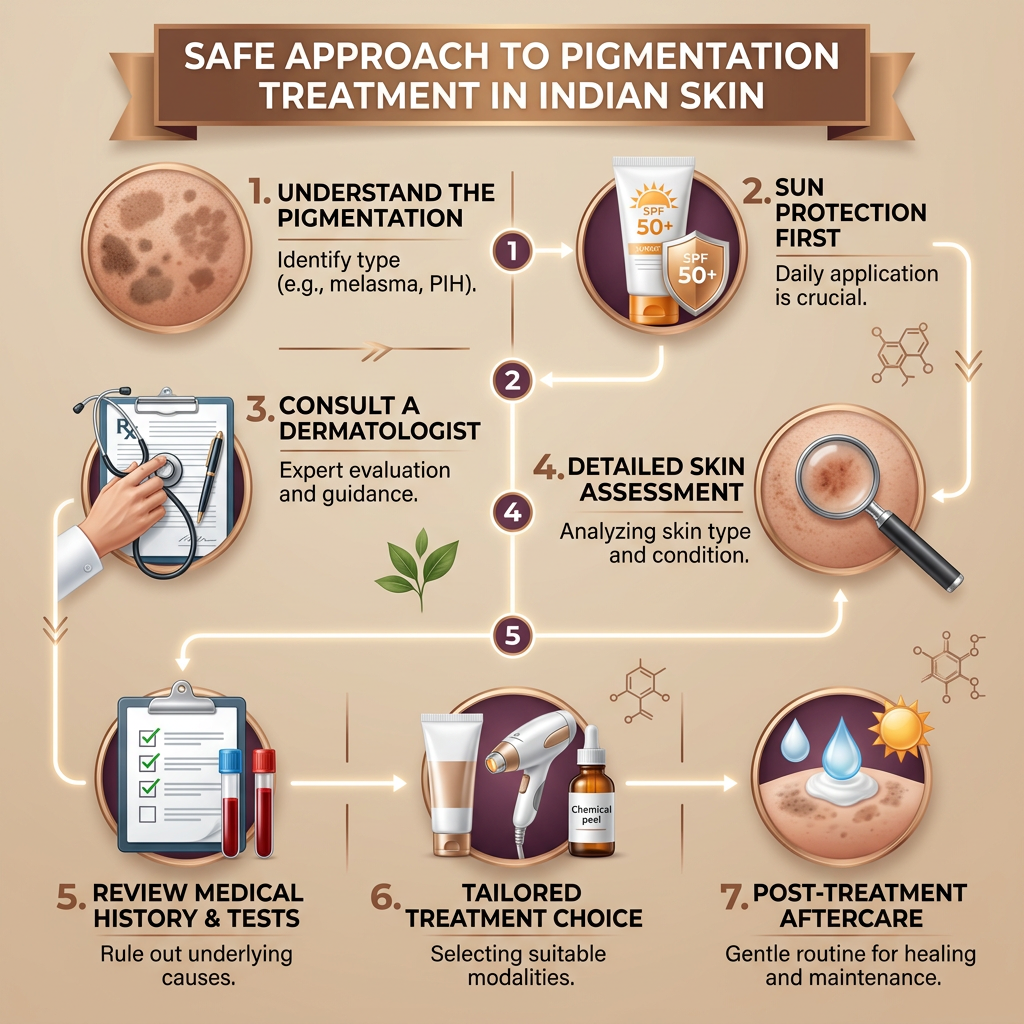
How to choose a safer path for pigmentation treatment
This section can also support HowTo schema in a compliant way because it helps users understand how to approach treatment responsibly.
Step 1: Notice whether the pigmentation is recent or recurring
Recurring pigmentation often needs a different conversation from a one-time post-acne mark or tanning episode.
Step 2: Avoid self-treating aggressively
Do not assume that stronger exfoliation, random peels, or copied routines will automatically help.
Step 3: Protect the skin from sun and heat
Strict and consistent protection is often essential in pigmentation management.
Step 4: Seek professional evaluation
An in-person consultation may help identify whether the concern appears to be melasma, post-inflammatory pigmentation, tanning-related discolouration, or a mixed pattern.
Step 5: Do any advised assessments or tests if recommended
In selected cases, additional evaluation may help clarify triggers and improve treatment selection.
Step 6: Choose treatment based on diagnosis, not trend
Peels, topical plans, Q-Switch Laser, or other options should be chosen according to the skin’s behaviour and the doctor’s assessment.
Step 7: Follow aftercare and maintenance advice carefully
Pigmentation often requires consistency, protection, and follow-up rather than one isolated procedure.
When should you seek treatment for pigmentation in Noida?
You should consider consultation if:
- facial pigmentation keeps returning
- dark patches are becoming more visible
- melasma is suspected
- you are unsure whether the concern is tanning, marks, or persistent pigmentation
- past creams, peels, or facials have not helped
- the skin becomes irritated easily
- you are considering laser or peel treatment and want to know whether it is appropriate for your skin
This is where the blog can naturally support higher-intent search behaviour such as:
- pigmentation treatment in Noida
- melasma treatment in Noida
- Q-Switch laser for pigmentation
- treatment for dark patches on face
- pigmentation laser consultation Noida
Final word
Pigmentation in Indian skin often needs more respect, more caution, and more diagnosis-led planning than people expect.
The goal should not be to rush into the strongest treatment. The goal should be to understand:
- what kind of pigmentation is present
- whether the skin is reactive
- whether melasma or recurrence is involved
- whether peels or Q-Switch Laser are even suitable
- what triggers also need correction
At Bare & Beauty Aesthetic and Wellness, pigmentation treatment should begin with in-person consultation and personalised assessment, not with assumptions or trend-based shortcuts. Whether the eventual discussion involves Pigmentation & Discoloration Treatment, Melasma Treatment, or Q-Switch Laser Treatment, the safest path is the one chosen carefully for the individual skin, medical history, and trigger pattern.
FAQs
1. Why does pigmentation in Indian skin need more careful treatment?
Indian skin may be more prone to post-inflammatory darkening, recurrence, and pigment reactivity after irritation, heat exposure, or unsuitable treatment.
2. Is all facial pigmentation the same?
No. Facial pigmentation may represent melasma, post-inflammatory pigmentation, tanning-related unevenness, or other mixed patterns that need different treatment logic.
3. Can the wrong peel worsen pigmentation?
In some cases, yes. If the skin is sensitive or the pigmentation type is not properly assessed, an unsuitable peel may worsen irritation and make pigmentation more difficult to manage.
4. Is Q-Switch Laser suitable for all pigmentation?
No. Q-Switch Laser may be discussed in selected cases, but not every pigmentation concern is suitable for the same laser-based approach.
5. What tests may a doctor advise before pigmentation treatment?
Depending on the history and pattern, a doctor may sometimes advise selected assessment steps or tests such as clinical skin evaluation, thyroid profile, blood sugar review, or other relevant investigations where indicated.
6. Can habits and sun exposure worsen pigmentation?
Yes. Poor sunscreen use, heat exposure, friction, random actives, and inconsistent aftercare may all contribute to persistent or recurring pigmentation.
7. When should I seek pigmentation treatment in Noida?
If pigmentation is recurring, worsening, resistant to routine care, or you are considering peels or laser and want to know what is safest for your skin, consultation is advisable.