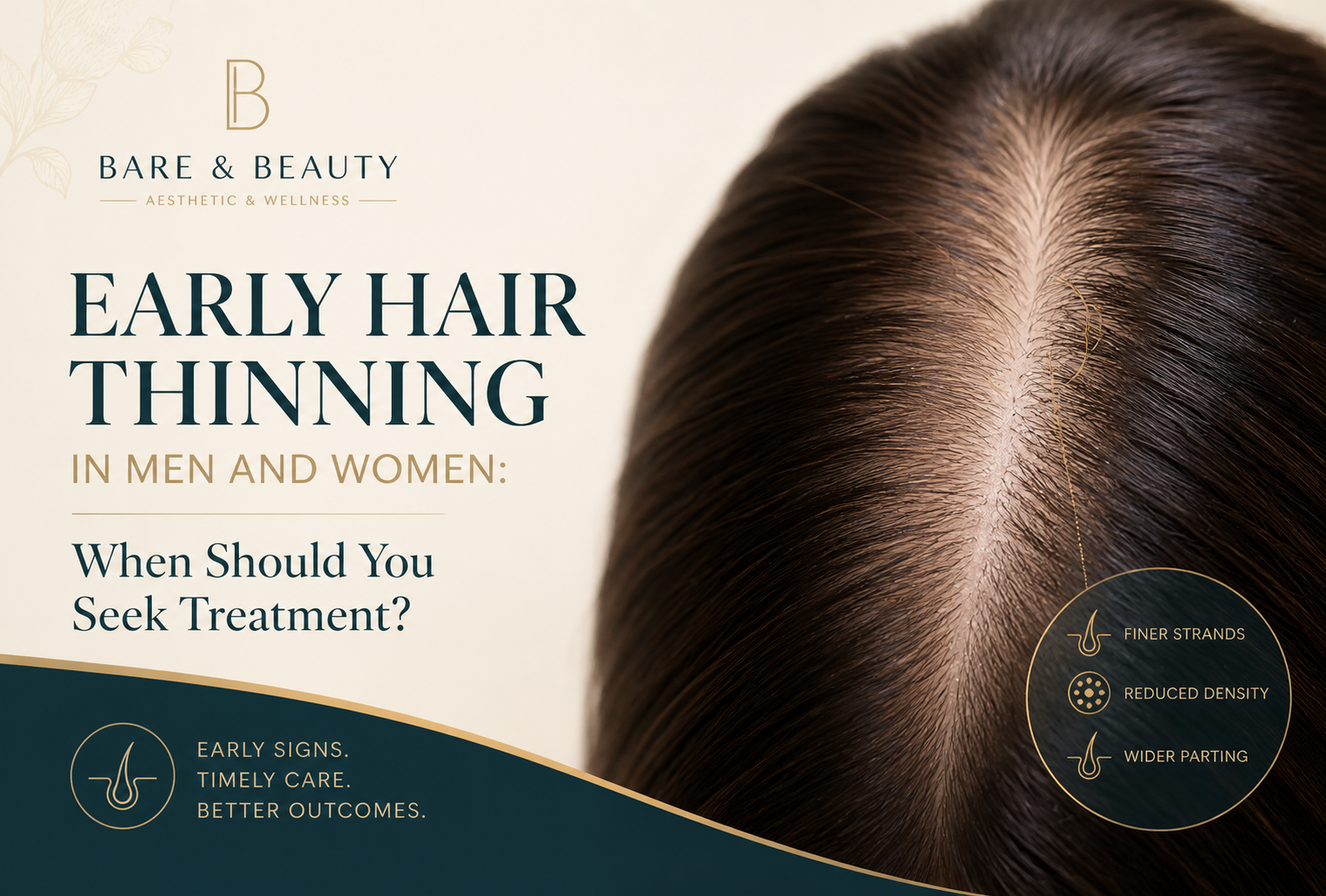
Early Hair Thinning in Men and Women: When Should You Seek Treatment?
Hair thinning often begins quietly. It may not look dramatic in the beginning. There may be no obvious bald patch, no sudden shock, and no immediate reason to panic. Instead, the signs usually appear gradually. A wider parting, a little more scalp visibility, extra hair on the pillow, or a ponytail that feels thinner than before may be the first clues.
Because these early changes are subtle, many people delay seeking help. Some assume it is seasonal. Others believe it will settle on its own. Many wait until thinning becomes clearly visible in photographs, under bright light, or after a significant drop in hair density. By that stage, the problem may already be more established than it appears.
That is why early evaluation matters. Hair thinning is often easier to assess and plan for when addressed before advanced loss develops. At Bare & Beauty Aesthetic and Wellness, treatment decisions are consultation-based and may involve options such as PRP for Hair Loss, GFC Therapy, QR678, Hair Mesotherapy, Exosomes for Hair, and supportive scalp-health approaches depending on suitability after in-person assessment .
What Is Early Hair Thinning?
Early hair thinning usually means a gradual reduction in hair density, thickness, or overall volume before obvious baldness develops. It may affect men and women differently.
In men, thinning often starts around the temples, hairline, or crown. In women, it more commonly shows up as diffuse thinning, widening of the parting, reduced ponytail volume, or loss of fullness over the central scalp. The pattern may be subtle at first, but that does not always mean it is insignificant.
Hair thinning is not a diagnosis by itself. It is a visible sign that needs interpretation. The underlying reason may vary from person to person, which is why self-diagnosis is often misleading.
Common Early Signs That Should Not Be Ignored
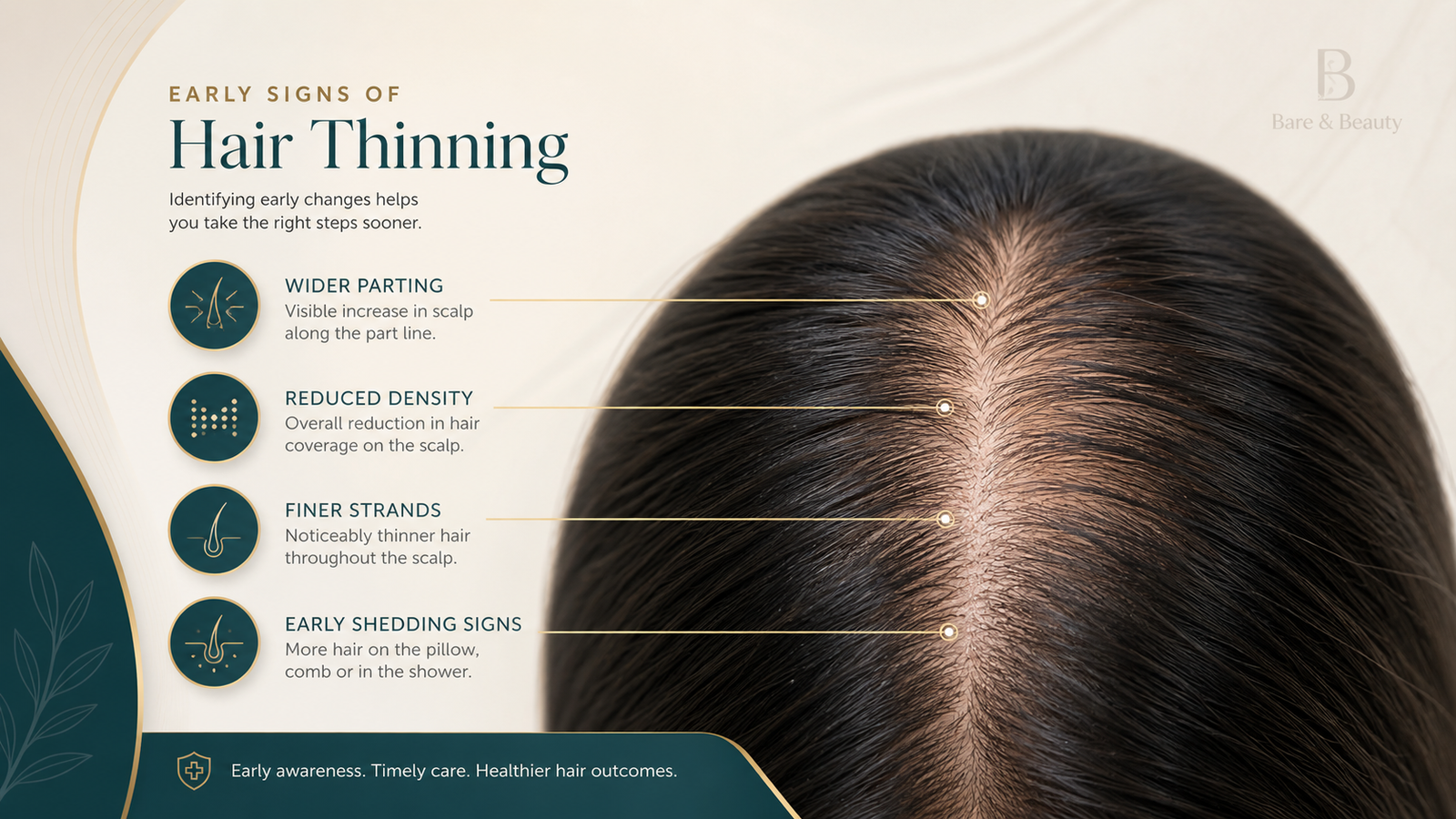
Some of the most common early warning signs include:
1. Increased Hair Shedding for Several Weeks
A temporary increase in shedding can happen after stress, illness, travel, poor sleep, nutritional imbalance, or hormonal disruption. However, if shedding continues for weeks and recovery does not seem to happen, it deserves attention.
2. Noticeable Reduction in Hair Volume
Many people first notice thinning not in the mirror, but while tying their hair, styling it, or washing it. A ponytail may feel thinner, hair may look flatter, or the scalp may become more visible than before.
3. Widening of the Hair Parting
This is especially common in women. A widening parting may be one of the earliest visible signs of progressive thinning.
4. Receding Hairline or Thinning at the Temples
In men, early recession around the temples or change in hairline shape may indicate the beginning of patterned hair loss.
5. Scalp Visibility Under Light
If the scalp becomes more visible under indoor lighting, flash photography, or after washing the hair, it may suggest a reduction in density.
6. Change in Hair Texture or Strand Thickness
Hair may not just fall more. It may also become finer, weaker, and less full. Miniaturisation of hair shafts can happen before obvious baldness develops.
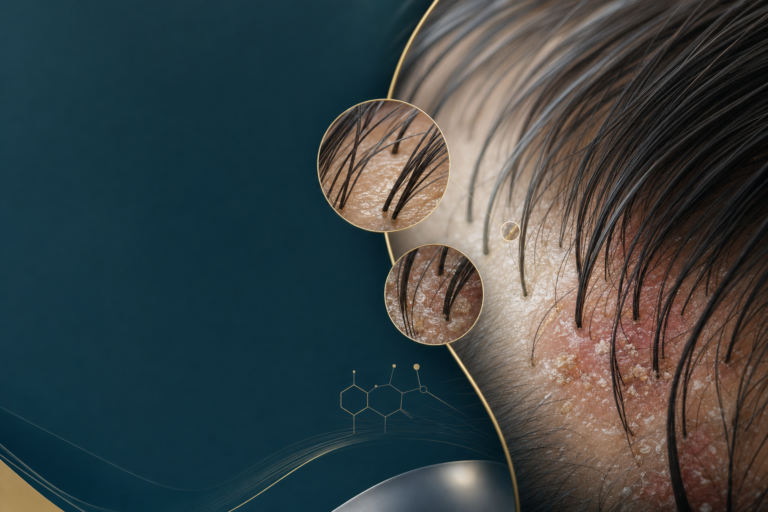
7. Itching, Flaking, or Scalp Discomfort Along With Thinning
Scalp health can influence hair quality. Irritation, buildup, excessive oiliness, dandruff, or inflammation may coexist with hair thinning and should not be ignored.
Why People Delay Treatment
The biggest reason is that early hair thinning often feels uncertain. People are not sure whether it is serious enough. They may compare themselves to others, try home remedies, or assume that supplements alone will solve the issue.
There is also a psychological tendency to wait for a “clear problem.” But in hair loss, waiting for certainty can sometimes mean waiting until the condition progresses further. Consultation does not always mean immediate procedure. It means getting clarity before the situation becomes harder to manage.
When Should You Seek Professional Evaluation?
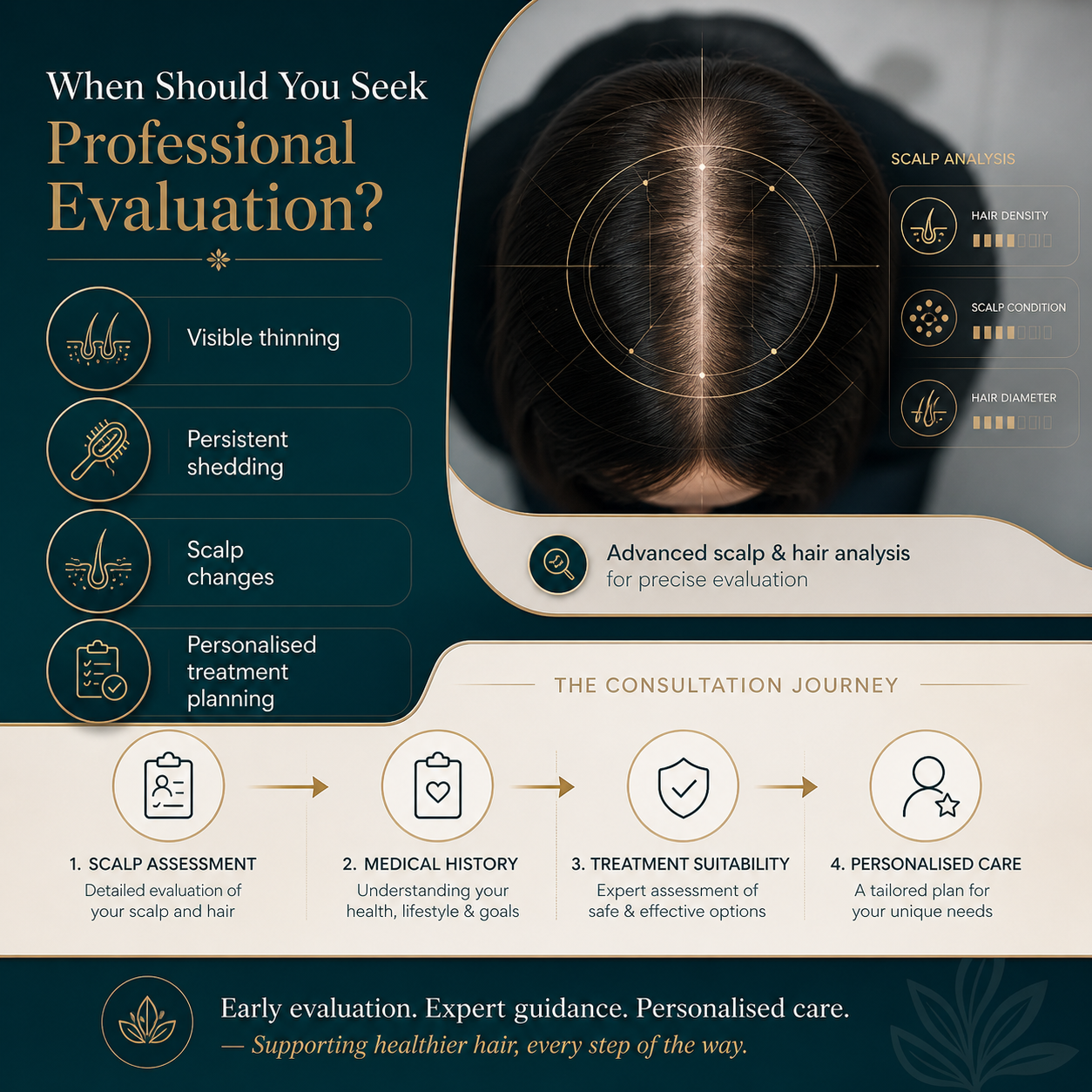
You should consider seeking evaluation when one or more of the following are present:
- Hair thinning has been noticeable for more than 6 to 8 weeks
- Shedding feels persistently higher than usual
- Hairline, crown, or parting changes are becoming visible
- Hair density is clearly reducing over time
- You have a family history of hair loss
- Thinning is affecting confidence or daily appearance concerns
- You have had recent illness, stress, hormonal shifts, or nutritional disruption
- Scalp issues such as dandruff, itching, or inflammation are present alongside thinning
- You have already tried basic care without improvement
Early consultation is particularly important when thinning is progressive rather than temporary.
Is Hair Thinning the Same in Men and Women?
No. While some causes may overlap, the presentation and pattern often differ.
In Men
Men are more likely to develop patterned thinning around the temples, frontal hairline, and crown. Progression can be gradual but persistent. Many men notice recession first and density loss later.
In Women
Women more commonly experience diffuse thinning, reduced volume, central scalp visibility, or widening parting rather than a sharply receding hairline. Hormonal factors, nutritional issues, stress, postpartum changes, or underlying medical causes may also need consideration.
Because the patterns differ, treatment planning should not be one-size-fits-all.
What Can Cause Early Hair Thinning?
Hair thinning may be linked to one or more contributing factors, such as:
- Genetic predisposition
- Hormonal influences
- Stress-related shedding
- Nutritional deficiency
- Scalp inflammation
- Lifestyle imbalance
- Medical conditions
- Post-illness recovery
- Postpartum changes
- Age-related reduction in density
- Inadequate scalp care
This is one reason why consultation matters. The same visible complaint can have different underlying drivers.
Why Early Treatment Planning Matters
Hair treatment is not only about regrowing lost hair. It is also about protecting existing hair, improving scalp condition, slowing further thinning where possible, and choosing the right approach at the right stage.
When people wait too long, they may be dealing with:
- lower density to work with
- longer timelines
- more advanced miniaturisation
- greater emotional distress
- less flexibility in treatment planning
Early-stage intervention can allow more structured planning. It may also help distinguish between temporary shedding and ongoing thinning.
What Kind of Treatments May Be Considered?
At Bare & Beauty, hair treatment recommendations are made only after in-person consultation and depend on individual suitability. The clinic’s available hair and scalp treatment portfolio includes PRP for Hair Loss, GFC Therapy, QR678 Treatment, Hair Mesotherapy, Exosomes for Hair Regeneration, MNFR where indicated, and Hydrafacial Keravive for scalp health support .
PRP for Hair Loss
PRP uses platelet-rich plasma derived from the patient’s own blood as part of a regenerative hair-restoration approach. It is commonly considered in selected cases of early thinning and supportive hair treatment planning.
GFC Therapy
GFC is a growth-factor-based approach that may be considered in suitable hair-loss cases after assessment.
QR678
QR678 may be considered in selected patients as part of a structured approach to thinning and density concerns.
Hair Mesotherapy
Mesotherapy may be used in some cases where targeted scalp-based supportive treatment is considered appropriate.
Exosomes for Hair
Exosome-based regenerative support may be considered in suitable cases depending on consultation findings.
Hydrafacial Keravive and Scalp Health Support
Scalp health can influence hair quality and treatment readiness. In cases where scalp buildup, dryness, imbalance, or poor scalp hygiene are contributing concerns, supportive scalp therapies may be relevant.
Not every person needs every treatment. Not every thinning pattern requires procedural intervention. The value of consultation lies in identifying what is appropriate, what is not, and what should be prioritised first.
Can Early Hair Thinning Improve on Its Own?
Sometimes, yes. Temporary shedding related to stress, illness, poor sleep, or short-term disruption may improve once the trigger settles. But visible thinning that continues, progresses, or becomes patterned should not be assumed to be self-correcting.
The challenge is that many people cannot reliably distinguish temporary shedding from progressive thinning without proper evaluation. That uncertainty is exactly why it is better to seek guidance earlier rather than later.
What Happens During a Hair Consultation?
A proper consultation is not just about being told to “take a treatment.” It is about understanding the pattern, timeline, symptoms, history, and likely contributing factors.
A consultation may involve:
- discussion of when thinning began
- review of shedding pattern
- assessment of scalp and density changes
- evaluation of medical and lifestyle history
- identification of treatment suitability
- discussion of realistic expectations
- explanation of whether supportive, regenerative, or staged treatment may be considered
This process helps move the conversation away from guesswork and towards informed decision-making.
Realistic Expectations Matter
Hair treatment requires patience. Visible improvement, if achieved, is usually not immediate. Some cases may need a staged plan. Others may need supportive care, monitoring, or multiple sessions depending on the nature of the concern.
No ethical clinic should promise guaranteed regrowth or instant reversal. Results vary between individuals. Suitability, response, scalp condition, medical background, compliance, and biological factors all matter. Bare & Beauty follows a consultation-led, informed-consent-based approach and does not position treatment outcomes as guaranteed .
When Waiting Becomes Riskier
You do not need to panic over every strand of hair. But you also should not ignore patterns that are persisting and becoming more visible. If you have been noticing gradual reduction in density, widening parting, thinning around the temples, or ongoing shedding that does not settle, delaying assessment may reduce your options over time.
Seeking help early does not commit you to treatment. It helps you understand the situation before assumptions turn into avoidable progression.
Final Thought
Early hair thinning is often easier to dismiss than to detect. That is why so many people seek help only after the change becomes obvious. But hair concerns do not need to become severe before they deserve attention.
If the scalp is becoming more visible, the density is changing, or shedding has continued long enough to make you concerned, it is reasonable to seek consultation. Early clarity is often more useful than late regret.
At Bare & Beauty Aesthetic and Wellness, hair concerns are approached through in-person consultation, careful assessment, and suitability-based planning. The aim is not to oversell treatment, but to understand the pattern early and guide the next step responsibly.
FAQs
1. How do I know if my hair thinning is normal or a sign of hair loss?
A small amount of daily hair fall can be normal, but persistent thinning, visible reduction in density, widening parting, or recession at the temples may indicate the need for evaluation.
2. When should men seek treatment for early hair thinning?
Men should consider consultation when they notice temple recession, crown thinning, visible scalp, or gradual reduction in density over several weeks or months.
3. When should women seek treatment for hair thinning?
Women should seek assessment if they notice widening parting, reduced ponytail volume, diffuse scalp visibility, or persistent hair shedding that does not settle.
4. Is it better to treat hair thinning early?
Early evaluation can help identify the cause sooner and may support more structured treatment planning before thinning becomes more advanced.
5. Can stress cause early hair thinning?
Stress can contribute to shedding in some cases, but if hair thinning continues or becomes visibly progressive, consultation is advisable.
6. What treatments may be considered for early hair thinning?
Depending on suitability after consultation, options may include PRP for Hair Loss, GFC Therapy, QR678, Hair Mesotherapy, Exosomes for Hair, or supportive scalp-health treatments at Bare & Beauty.
7. Does every person with hair thinning need PRP or GFC?
No. Treatment choice depends on individual assessment, pattern of thinning, scalp condition, and medical suitability. Not everyone needs the same plan.
8. Can scalp health affect early hair thinning?
Scalp condition can influence hair quality and treatment readiness. In some people, scalp imbalance, buildup, or irritation may coexist with thinning concerns.
9. Are hair-thinning treatments guaranteed to work?
No ethical clinic should guarantee outcomes. Response varies from person to person and depends on multiple medical and biological factors.
10. Is consultation necessary before starting hair treatment?
Yes. Hair thinning should be evaluated properly before planning treatment. Bare & Beauty follows an in-person consultation-only approach before any procedure is considered.