PRP vs GFC for Hair Loss: What Is the Difference?
Hair loss treatment conversations have become more informed over the last few years. People no longer ask only whether a treatment exists. They increasingly want to know which treatment may be more suitable, how the options differ, and whether one approach is better aligned with their specific stage of hair thinning.
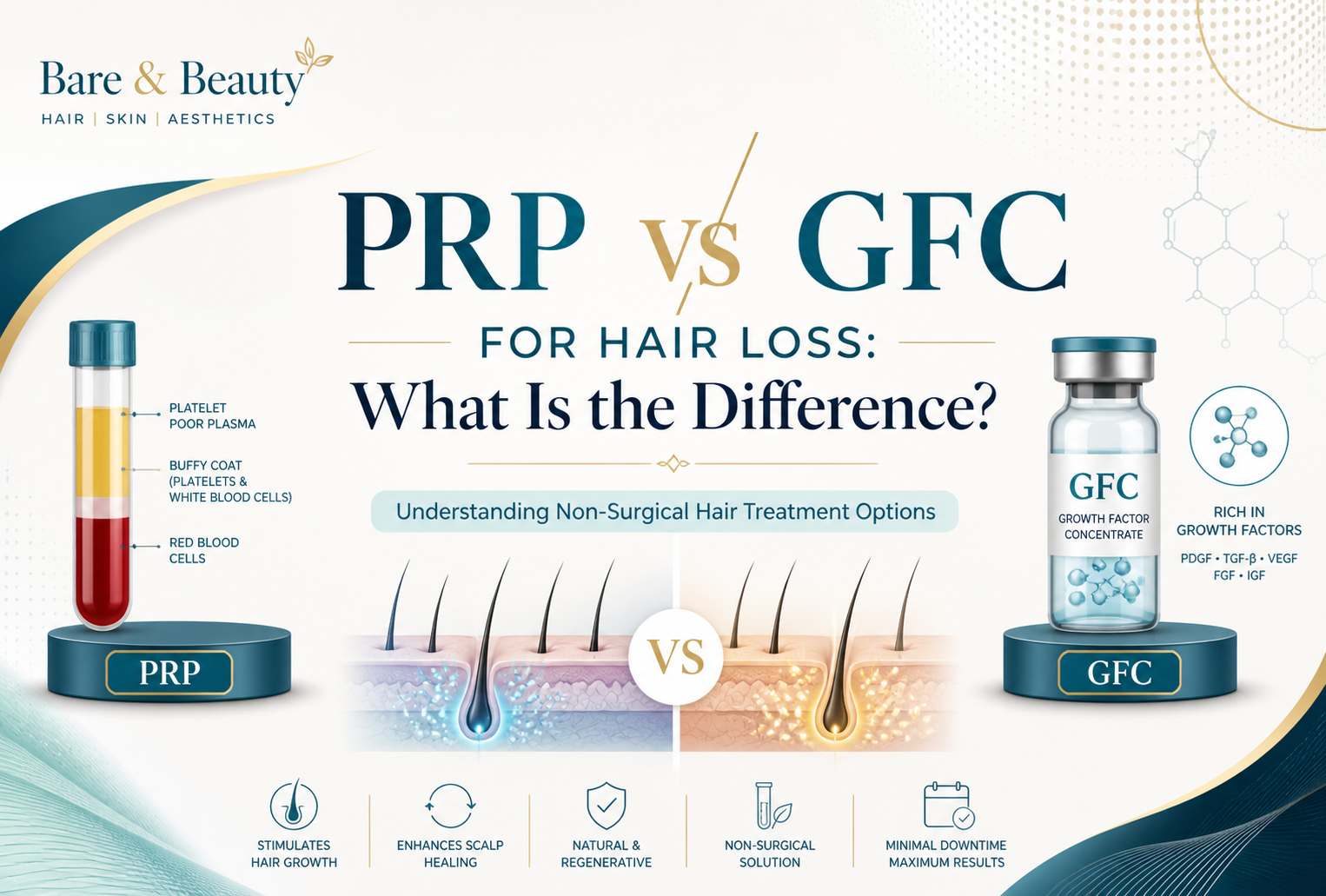
Among the most commonly discussed options are PRP and GFC. These two terms often appear together in online searches, clinic pages, and patient conversations. Many people assume they are the same treatment with different names. Others believe one is always better than the other. In reality, the difference is more nuanced.
At Bare & Beauty Aesthetic and Wellness, Noida, hair-loss treatment planning is intended to be consultation-led and personalised. The clinic’s hair vertical is structured around dedicated pages such as PRP for Hair Loss, GFC Therapy, and the broader Hair Treatments hub. That structure itself reflects an important principle: treatment decisions should follow assessment, not assumptions.
This blog explains the difference between PRP and GFC in simple, patient-friendly language.
Why people compare PRP and GFC
PRP and GFC are often compared because both are discussed in the context of hair-loss management, especially in people who are experiencing:
- early hair thinning
- gradual reduction in hair density
- increased shedding
- widening of the part line
- thinning near the crown or temples
- reduced hair volume over time
Since both are associated with regenerative or supportive hair treatment pathways, patients often ask:
- What is PRP?
- What is GFC?
- How are they different?
- Is one better for hair loss?
- Which one should I choose?
These are valid questions. However, the most responsible answer is that the right choice depends on the cause of hair loss, the stage of thinning, scalp condition, treatment goals, and medical assessment.
What is PRP for hair loss?
PRP stands for Platelet-Rich Plasma.
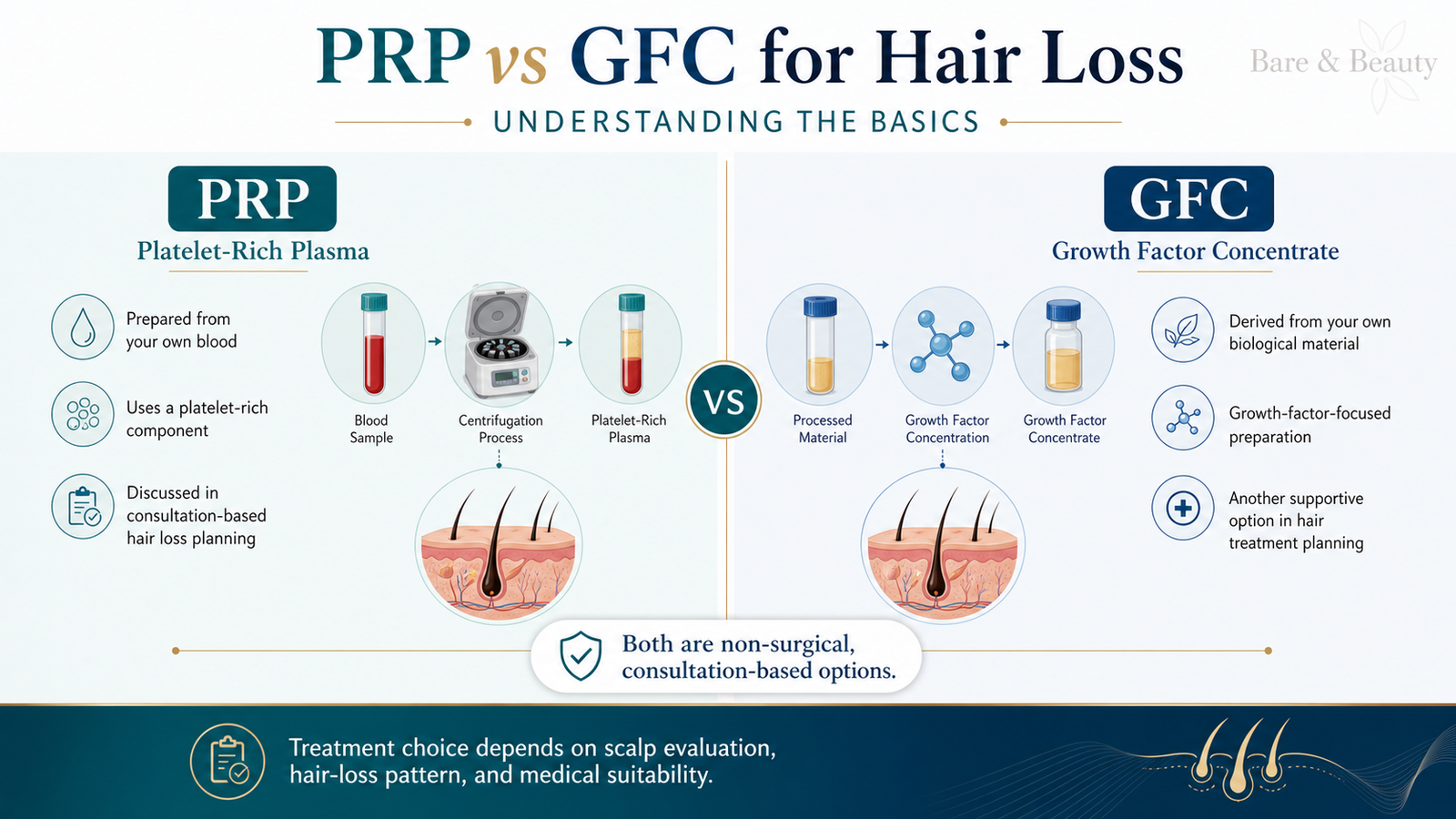
In simple terms, PRP is a treatment approach that uses a concentrated platelet-rich component derived from the individual’s own blood. Platelets contain growth factors and signalling components that are often discussed in regenerative medicine and supportive treatment planning.
In the context of hair loss, PRP may be considered as part of a medically guided treatment pathway for selected patients. It is commonly discussed when the aim is to support scalp health and hair-growth-related processes in a non-surgical setting.
At a high level, the process generally involves:
- drawing a small amount of the patient’s blood
- processing it in a controlled way
- separating the platelet-rich component
- using that prepared material as part of the treatment procedure
The exact protocol may vary depending on the clinic’s system, treatment planning, and case selection.
What is GFC therapy for hair loss?
GFC usually refers to Growth Factor Concentrate.
GFC is also discussed as a regenerative-support treatment option in hair-loss management. Like PRP, it is linked to the patient’s own biological material. However, the way it is processed and prepared is discussed somewhat differently.
In simple patient terms, GFC is often described as a more refined or selectively prepared growth-factor-focused approach. It is meant to concentrate useful signalling components that may be considered in hair-loss treatment planning.
Like PRP, GFC is typically discussed in the setting of:
- non-surgical hair-loss treatment
- early to moderate thinning in selected patients
- supportive treatment pathways
- consultation-based, session-oriented care
Because both PRP and GFC are grounded in regenerative-style treatment thinking, they are often compared directly.
PRP vs GFC: the basic difference
The difference between PRP and GFC is not just the name.
At a broad level:
- PRP is commonly understood as platelet-rich plasma prepared from the patient’s blood
- GFC is commonly described as a growth-factor-concentrated preparation, also derived from the patient’s own biological material but processed with a different logic
For patients, the practical takeaway is this:
Both are part of consultation-based hair-loss treatment planning, but they are not identical in preparation or treatment conversation.
PRP vs GFC for hair loss: quick comparison table
| Factor | PRP | GFC |
|---|---|---|
| Full form | Platelet-Rich Plasma | Growth Factor Concentrate |
| Broad treatment category | Regenerative/supportive hair treatment | Regenerative/supportive hair treatment |
| Source | Patient’s own blood-derived preparation | Patient’s own blood-derived growth-factor-focused preparation |
| General planning context | Commonly discussed in hair-loss management | Commonly discussed in hair-loss management |
| Treatment choice depends on | Hair-loss pattern, scalp assessment, medical suitability | Hair-loss pattern, scalp assessment, medical suitability |
| Is one universally better? | No | No |
| Best approach | Based on in-person consultation | Based on in-person consultation |
This table is intentionally simplified for patient education. Final treatment decisions should always be based on consultation rather than internet comparisons alone.
Why the choice is not only about the treatment name
One of the biggest mistakes patients make is choosing a treatment name before understanding the actual cause of hair loss.
Hair loss is not one single condition. A person may be experiencing:
- pattern hair thinning
- diffuse shedding
- stress-related hair fall
- nutrition-related loss
- hormonal influence
- post-illness shedding
- scalp-related factors
- mixed causes
That means the question is not only:
“PRP or GFC?”
The better question is:
“What is causing the hair loss, and which treatment pathway may be appropriate for this case?”
That is why Bare & Beauty’s content strategy for the hair cluster should not be sales-led. It should remain diagnosis-aware and planning-oriented.
When PRP may be discussed
PRP may be discussed in consultation when the clinic is evaluating non-surgical supportive options for hair thinning in selected individuals.
It is often part of conversation around:
- early-stage thinning
- reduction in hair density
- supportive scalp-treatment pathways
- combination hair-restoration planning
- patients looking for consultation-based non-surgical options
This does not mean PRP is suitable for everyone. It also does not mean every person with hair fall needs PRP.
Suitability depends on:
- the type of hair loss
- overall scalp condition
- medical history
- stage of thinning
- patient expectations
- whether another treatment approach or combination strategy is more appropriate
When GFC may be discussed
GFC may also be discussed in similar consultation settings where regenerative-support hair-loss treatment is being considered.
It may come into conversation when the goal is to explore:
- supportive treatment for thinning hair
- consultation-based non-surgical options
- treatment planning that includes biologically derived growth-factor-focused support
- selected patients looking at PRP-like but distinct pathways
Again, it is important not to frame GFC as automatically superior or universally more effective. That would not be medically responsible.
The right approach is to say:
- GFC is another treatment option that may be discussed
- it differs from PRP in its preparation logic
- final suitability depends on assessment
Is PRP better than GFC?
This is the most common question, and the most responsible answer is:
Not universally.
There is no ethical reason to say that one is always better for every patient. That kind of claim oversimplifies hair-loss treatment and creates unrealistic expectations.
A more accurate answer is:
- one person may be guided toward PRP
- another may be guided toward GFC
- some may be advised a different treatment pathway
- some may need combination planning
- some may first need cause evaluation rather than procedure selection
At Bare & Beauty, the positioning should remain consultation-based, not treatment-name-driven.
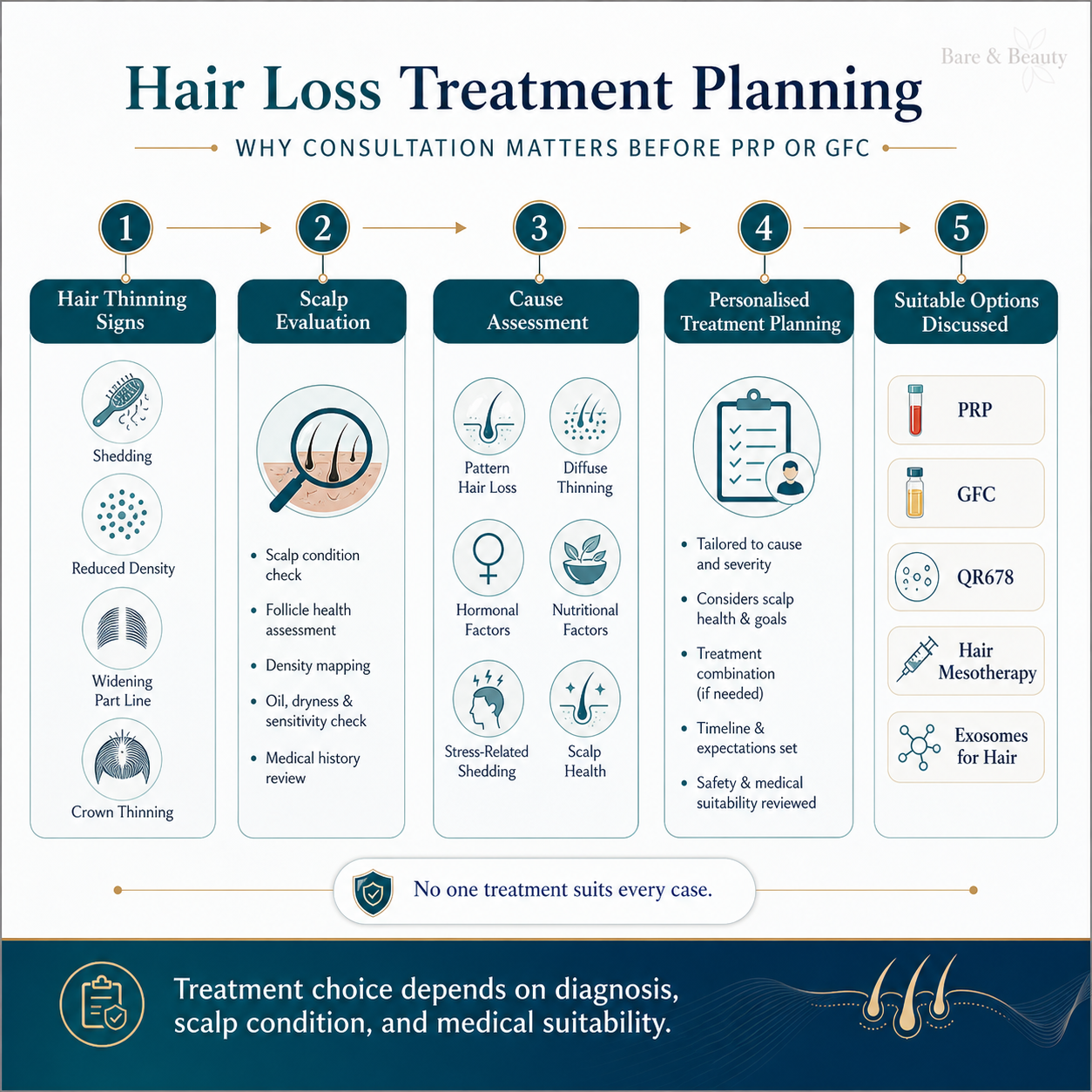
What matters more than PRP vs GFC
For many patients, these factors matter more than the treatment label:
1. Cause assessment
Hair loss should first be understood properly.
2. Stage of thinning
Early thinning and advanced thinning may not be approached in the same way.
3. Scalp evaluation
Scalp condition can influence treatment planning.
4. Treatment goals
The patient’s concern may be shedding, density, thinning, or long-term maintenance support.
5. Combination planning
In some cases, the better approach may involve a broader treatment strategy rather than relying on one standalone option.
6. Realistic expectations
No hair-loss treatment should be presented as a guaranteed or universal answer.
Why in-person consultation matters before choosing PRP or GFC
Hair-loss treatment should not be selected like a retail product.
An in-person consultation may help assess:
- whether the person has active hair thinning
- whether the cause seems pattern-related, diffuse, or mixed
- whether the scalp needs further evaluation
- whether PRP or GFC is relevant at all
- whether another pathway such as QR678, Hair Mesotherapy, or Exosomes for Hair may also enter the discussion
- whether the patient’s expectations are realistic
This is especially important for a premium clinic like Bare & Beauty, where the positioning should remain system-driven, ethical, and outcome-aware, rather than aggressive or hype-led
Who should consider professional evaluation for hair thinning?
A clinic consultation may be worth considering if you are noticing:
- increased hair shedding over weeks or months
- reduced density near the front, temples, or crown
- widening part line
- thinning in both men and women
- more scalp visibility than before
- lack of improvement despite routine changes
- uncertainty about whether the issue is temporary shedding or early thinning
This does not automatically mean PRP or GFC will be recommended. It means a professional evaluation can help clarify the next step.
Common mistakes patients make before consultation
1. Choosing a treatment only because it is trending
Popularity does not guarantee suitability.
2. Assuming one treatment suits all hair-loss cases
Hair loss has different causes.
3. Expecting instant or guaranteed regrowth
That creates unrealistic expectations.
4. Comparing price before comparing suitability
The treatment decision should begin with assessment, not package selection.
5. Ignoring early thinning
Delays can make planning less timely.
Final word
PRP and GFC are both important treatment conversations in non-surgical hair-loss management, but they are not the same. The difference lies not only in the name, but in how they are prepared, discussed, and selected as part of clinical planning.
The most important takeaway is this:
The right question is not simply “PRP or GFC?”
It is:
“What is causing the hair loss, and which treatment pathway is appropriate for my case?”
If you are experiencing hair thinning or want to understand whether PRP for Hair Loss or GFC Therapy may be relevant, the best next step is a consultation-based assessment at Bare & Beauty, Noida.
FAQs
1. What is the difference between PRP and GFC for hair loss?
PRP and GFC are both discussed as non-surgical supportive treatment options for hair loss, but they differ in how the preparation is processed and used in treatment planning. Final suitability depends on clinical evaluation.
2. Is PRP better than GFC for hair loss?
Not universally. The right choice depends on the cause of hair loss, stage of thinning, scalp condition, and individual suitability. One option should not be claimed as best for everyone.
3. Can both PRP and GFC be considered for men and women?
Yes, both may be discussed in men and women depending on the nature of hair thinning and the treatment plan advised after consultation.
4. Do all cases of hair fall need PRP or GFC?
No. Hair fall can occur for different reasons, and not every case requires regenerative treatment. Consultation helps determine whether these options are relevant.
5. How do doctors decide between PRP and GFC?
The decision may depend on the patient’s history, scalp assessment, hair-loss pattern, treatment goals, and whether a broader treatment plan is more suitable.
6. Are PRP and GFC permanent solutions for hair loss?
No treatment should be described as a guaranteed permanent solution. Hair-loss outcomes vary based on individual factors, and treatment plans may require ongoing review or combination approaches.