Acne vs Acne Scars: Why the Treatment Plan Is Not the Same
Acne and acne scars are often spoken about together, but they are not the same problem. That difference matters.
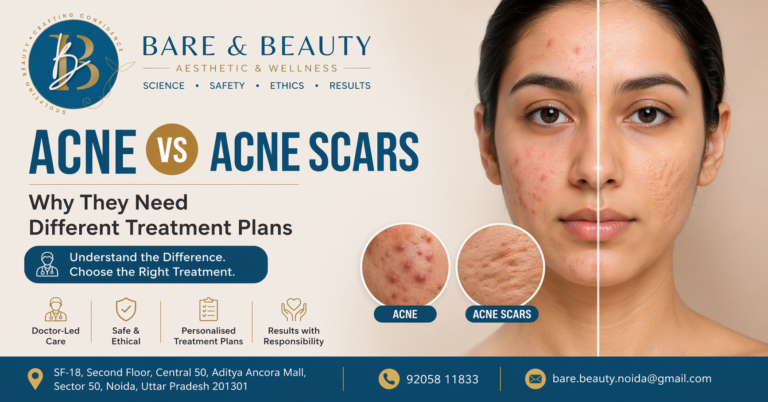
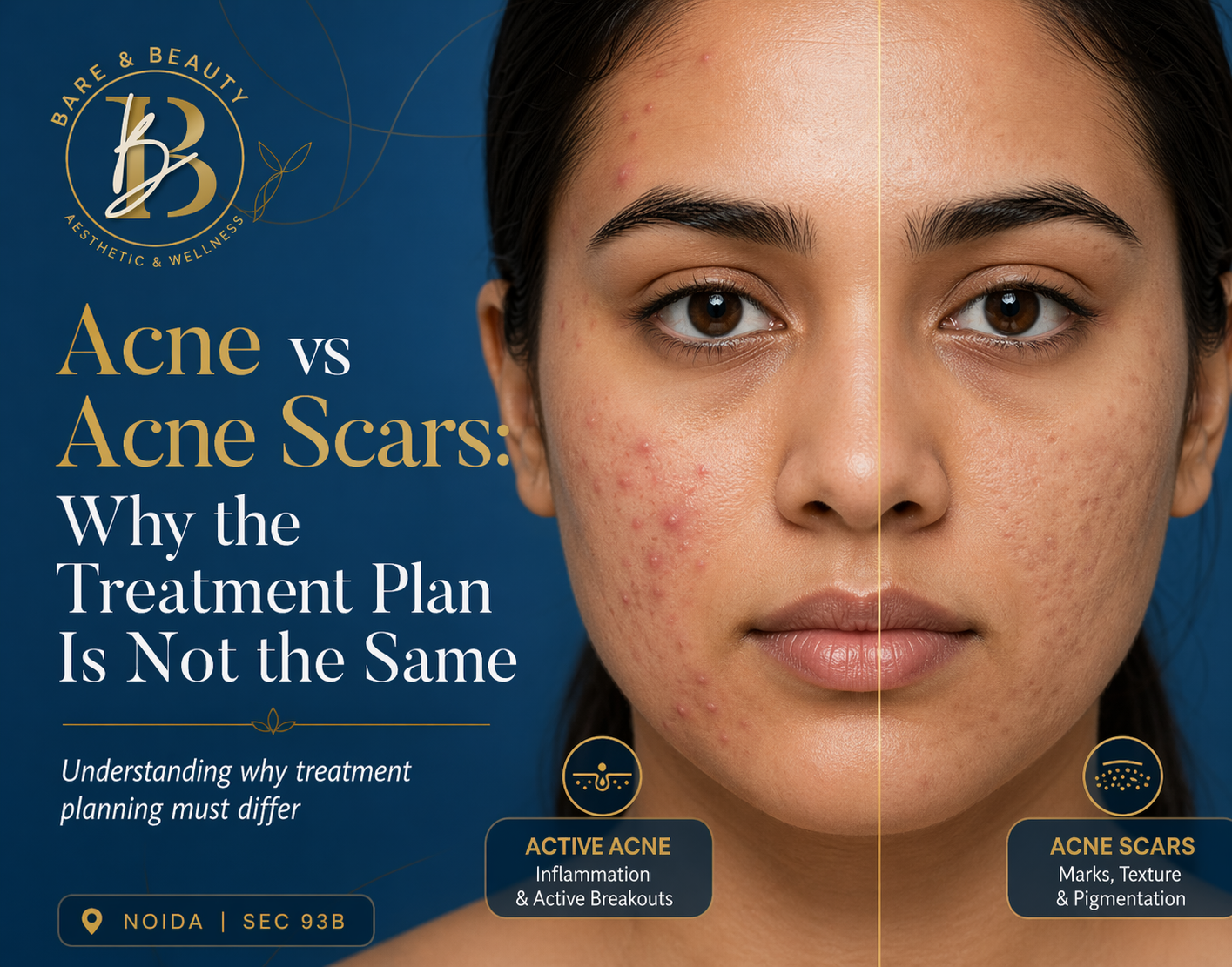
Many people assume that if a treatment helps with active acne, it will also improve old marks, pits, or uneven texture left behind. In reality, acne and acne scars usually require different treatment logic. One condition involves ongoing breakouts, inflammation, oil activity, and congestion. The other involves the after-effects of earlier inflammation, such as textural change, post-inflammatory marks, or deeper scar formation.
At Bare & Beauty Aesthetic and Wellness, treatment planning is based on what the skin is dealing with right now. If the skin still has active acne, the first goal is usually control and stability. If breakouts are already under control but the skin shows residual marks or textural scars, the plan may shift toward scar-focused or skin-repair procedures. Since Bare & Beauty offers both acne treatment and acne scar treatment as separate clinical categories, this distinction is central to proper planning.
Why people confuse acne and acne scars
The confusion is understandable because both conditions can appear on the same face at the same time.
A person may have:
- active pimples or inflamed breakouts,
- red or brown marks from recent acne,
- uneven skin texture from older acne,
- and deeper pits or depressions from long-standing scars.
Because all of these may coexist, people often look for one “best treatment.” But that approach can lead to frustration. Skin that is still acne-prone may not be ready for certain scar-focused procedures. On the other hand, someone with no active acne may not need an acne-control plan anymore and may benefit more from treatment that focuses on texture, collagen support, and scar revision.
What active acne usually means
Active acne generally refers to an ongoing breakout process. This may include:
- whiteheads,
- blackheads,
- papules,
- pustules,
- inflamed acne,
- oily or congestion-prone skin,
- and recurring eruptions in specific areas such as the cheeks, jawline, forehead, chest, or back.
In these cases, the treatment objective is usually to reduce active lesion formation, calm inflammation, support smoother turnover, and limit the chances of future worsening. Bare & Beauty’s treatment inventory specifically includes Acne Treatment and also lists Chemical Peels among the skin treatment options, which supports structured acne-management pathways where clinically appropriate.
What acne scars usually mean
Acne scars usually refer to changes left behind after the active breakouts have healed. These changes may include:
- depressed or pitted scars,
- uneven skin texture,
- rolling or boxcar-type textural changes,
- selected post-acne marks,
- and residual surface irregularity.
Not every post-acne mark is a true scar. Some people mainly have pigmentation or redness after acne, while others have actual structural changes in the skin. This is why scar treatment begins with diagnosis, not assumptions.
Bare & Beauty’s service inventory treats Acne Scar Treatment as a separate treatment category from acne itself, which aligns with this more precise planning approach.
Why the treatment plan is not the same
The main reason is simple: the treatment target changes.
When acne is active, the focus is often on:
- reducing breakouts,
- calming inflammation,
- controlling congestion,
- improving skin turnover,
- and preventing new lesions from leaving more marks.
When acne scars are the concern, the focus may shift toward:
- improving texture,
- supporting collagen remodelling,
- addressing depressed areas,
- and improving the overall surface quality of the skin.
A skin plan that is right for active acne may not be sufficient for established scars. Similarly, an aggressive scar-revision mindset may not suit skin that is still inflamed, sensitive, or actively breaking out.
A common real-world pattern
One of the most common situations is this:
A person starts getting acne in the teenage years or early adulthood. They try home remedies, online recommendations, or random topical products. Breakouts continue on and off. Over time, some lesions settle, but the skin begins to show darker marks, roughness, and pits. At that point, the person feels that “acne is gone,” yet the face still does not look clear.
This is where treatment planning needs to separate:
- what is still active,
- what is residual pigmentation,
- and what is true scarring.
Without that distinction, treatment tends to stay generic and outcomes remain inconsistent.
How active acne is usually approached
Active acne treatment is generally planned around the behaviour of the skin.
Depending on the individual presentation, the doctor may assess:
- acne type and severity,
- whether there is ongoing inflammation,
- oiliness and congestion pattern,
- trigger pattern,
- sensitivity of skin barrier,
- tendency for pigmentation,
- and whether the skin shows early scarring risk.
At Bare & Beauty, this type of planning can logically connect to acne treatment itself and, where medically suitable, to selected skin-support procedures such as superficial to medium-depth chemical peels listed in the clinic’s treatment inventory. The clinic’s internal content rules also require that treatment suitability be presented conservatively, without promises or exaggerated results.
Acne treatment may aim to support:
- congestion control,
- smoother skin turnover,
- reduction in active lesions,
- reduced inflammation,
- better maintenance planning,
- and lower risk of future post-acne marks.
How acne scar treatment is usually approached
Scar treatment is usually considered when active acne is either controlled or significantly reduced.
The planning logic may depend on:
- whether the marks are pigmented, red, or textural,
- how deep the scars are,
- whether scars are widespread or localised,
- how the skin heals,
- whether there is associated pigmentation,
- and whether combination treatment may be more appropriate.
Bare & Beauty’s treatment inventory includes Acne Scar Treatment and also includes advanced skin and anti-ageing procedures such as Subcision, Chemical Peels, and selected regenerative or resurfacing-support treatments where indicated in broader clinical practice. That does not mean every scar needs all of these. It means scar planning may be layered rather than one-dimensional.
Why treating acne first can matter
If active acne is still present, treating scars too early may not always be the first priority.
This is because:
- new breakouts can continue creating new marks,
- inflamed skin may react differently,
- irritation risk may increase,
- and the skin may need stabilisation before more targeted texture work is considered.
This does not mean scars must always wait completely. It means the order of treatment matters. In many cases, the first step is to calm active disease, then move toward mark management and scar-focused improvement more rationally.
Pigmentation after acne is not always the same as scarring
This is an important distinction, especially in Indian skin.
Many patients say they have “acne scars” when they are actually dealing mainly with:
- brown post-acne marks,
- uneven tone,
- or redness after healing.
Those concerns are real, but they are not identical to pitted scars. They usually need different treatment logic.
Bare & Beauty’s educational skin content around chemical peels also reflects this distinction by noting that treatment usefulness depends on the concern itself, and that acne-prone skin, pigmentation, dullness, and mixed concerns require different planning logic. It also specifically notes that Indian skin often needs cautious planning in pigmentation management.
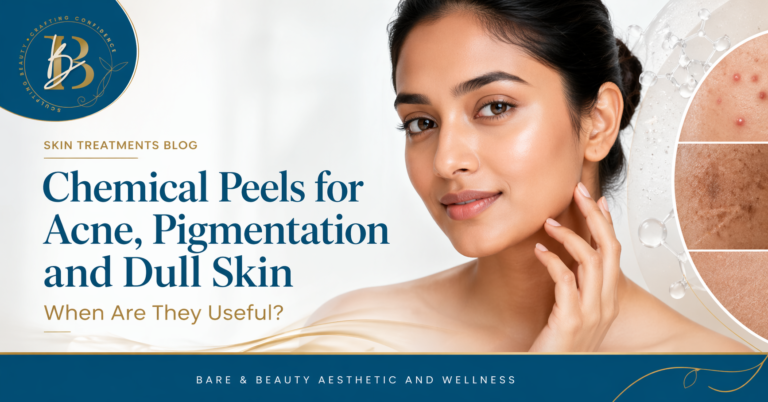
Where chemical peels may fit in
Chemical peels are often misunderstood as a one-size-fits-all solution.
In reality, their usefulness depends on:
- whether acne is active,
- whether the concern is mainly pigmentation,
- whether dullness is the dominant issue,
- whether the skin is sensitive,
- and whether multiple concerns exist together.
Bare & Beauty includes Chemical Peels as a dedicated treatment category, and its educational content already frames peels as concern-specific rather than universal. For acne-prone skin, the objective may be to support congestion control and smoother turnover. For pigmentation, the plan may need more caution. For dull skin, the goal may be surface freshness rather than aggressive peeling. For mixed concerns, combination planning may be more appropriate than relying on one intervention alone.
That is exactly why a peel that helps one person may not be the right first choice for someone else.
When combination planning becomes more important
Some patients do not have a single isolated concern. They may have:
- mild active acne,
- post-acne pigmentation,
- early scarring,
- and visible textural unevenness together.
In such cases, combination treatment may be more appropriate than searching for one “best treatment.” Bare & Beauty’s own educational framework for chemical peels recognises that mixed concerns often require a combination approach rather than reliance on one modality alone.
A combination plan may be staged across time rather than done all at once. The order, intensity, and spacing depend on the skin’s condition and the doctor’s assessment.
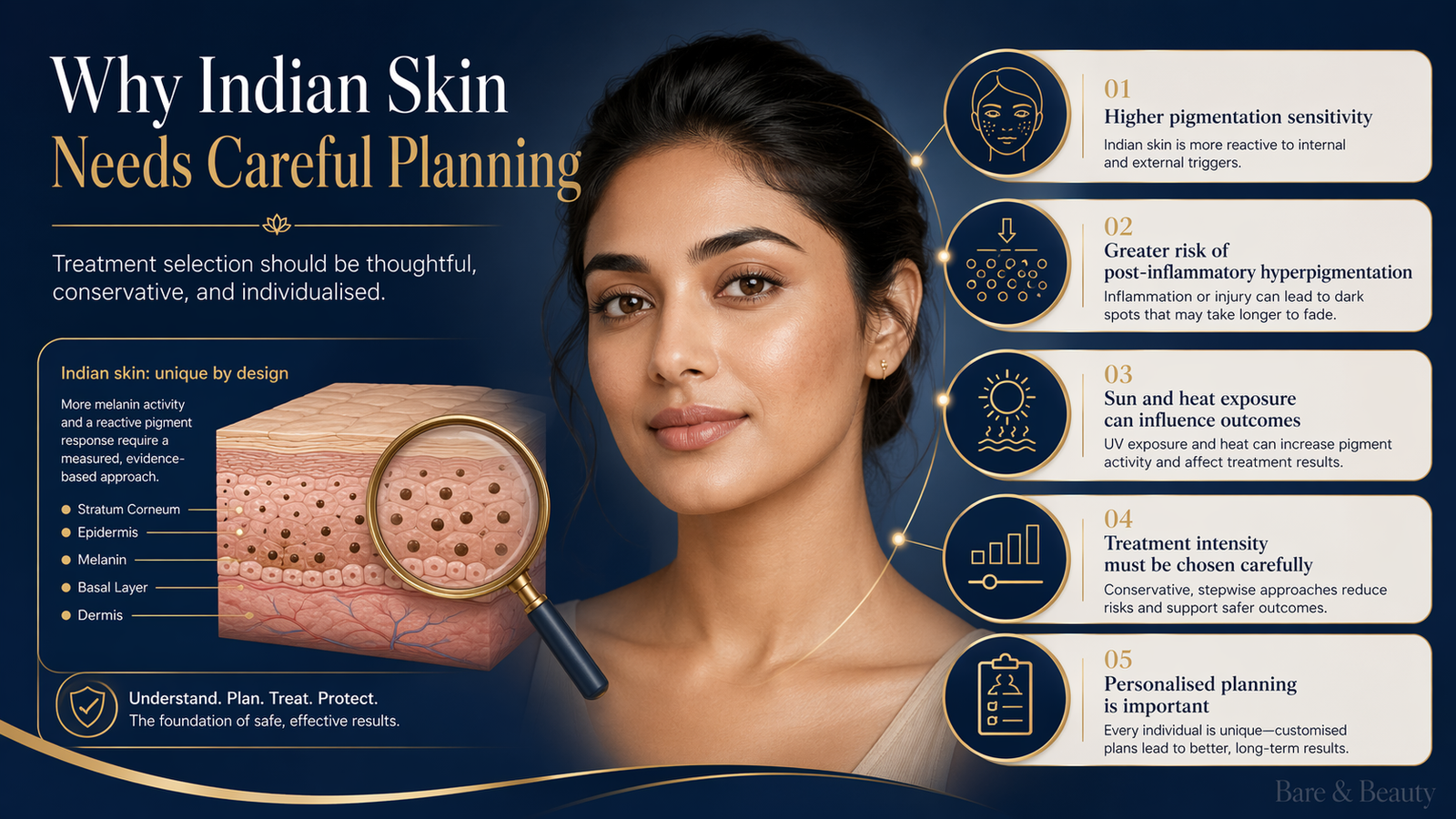
Why Indian skin needs careful planning
For Indian skin, over-treatment can be as important a concern as under-treatment.
When acne, pigmentation, and healing tendency overlap, the plan needs caution. Stronger or poorly timed procedures may increase irritation or worsen post-inflammatory pigmentation in selected cases. Bare & Beauty’s educational material explicitly notes that pigmentation planning in Indian skin often needs caution to reduce the risk of rebound pigmentation.
That is one reason consultation-based planning matters more than generic recommendations from social media or product trends.
What happens during a clinical assessment
A proper consultation for acne or acne scars may include evaluation of:
- whether acne is still active,
- how frequent breakouts are,
- how long the condition has been present,
- whether scars are superficial or deeper,
- whether marks are mainly pigment or texture,
- prior treatment history,
- skin sensitivity,
- and realistic treatment sequencing.
Bare & Beauty’s content and policy framework is clear that treatments are consultation-based, in-person, consent-driven, and do not guarantee uniform results. Treatment plans are personalised and guided by medical judgement.
What patients should avoid doing on their own
People often worsen the situation by:
- picking acne lesions,
- starting multiple actives together,
- using home peeling products without guidance,
- chasing quick fixes,
- switching products too frequently,
- or treating all post-acne changes as the same issue.
This can delay improvement and sometimes increase the chances of marks or irritation.
A better way to think about it
A simple way to think about the distinction is this:
Acne treatment usually focuses on controlling what is still happening.
Acne scar treatment usually focuses on improving what is left behind.
That is why the treatment plan is not the same.
The skin first needs to be understood correctly:
- Is the main issue current inflammation?
- Is it residual pigmentation?
- Is it textural scar formation?
- Or is it a mix of all three?
Only then can a plan be medically sensible.
When to seek assessment
You should consider an in-person evaluation if:
- acne is recurring frequently,
- breakouts are leaving dark marks,
- texture looks uneven after acne settles,
- older pits or scars are becoming more visible,
- home care has plateaued,
- or you are unsure whether you have active acne, pigmentation, or true scarring.
At Bare & Beauty Aesthetic and Wellness, acne treatment and acne scar treatment are structured as distinct service areas, which supports more accurate planning instead of generic treatment assumptions.
Final note
Acne and acne scars may look connected, but they are not clinically identical concerns. Treating them as if they are the same often leads to delay, confusion, and disappointment.
A better plan begins with identifying:
- what is active,
- what is residual,
- and what the skin can realistically tolerate.
Because treatment outcomes vary from person to person, the right pathway is usually consultation-based, not template-based. Bare & Beauty’s published policy framework also states clearly that no online diagnosis is provided, all treatments require in-person evaluation and informed consent, and results are not guaranteed.